
Episode 2
When Humans Start Working with AI
Key Takeaways
Most enterprises are still in the experimentation phase with AI, running pilots and proofs of concept without yet achieving organization-wide impact.
The AI initiatives that succeed are those that clearly move the P&L, either by driving revenue growth, increasing market share, or reducing operational cost.
Governance is becoming essential, not as a blocker to innovation, but as an enabler of scale, trust, and responsible adoption.
Ownership matters. AI initiatives stall when accountability for outcomes, data, and risk is unclear or fragmented.
AI is accelerating disruption on two fronts: internal productivity and external market competition from faster, leaner entrants.
Jobs “below the algorithm”, those that are highly structured, repeatable, and easily automated, are at greater risk of displacement.
There is a growing “augmentation gap” between workers who can effectively guide AI and judge output quality, and those who cannot.
Long-term enterprise advantage will come from creativity, judgment, and differentiation, not from automating the same workflows everyone else can now automate.
Donal’s Watershed Moment
Donal’s watershed moment came when he realized that human–AI collaboration is becoming faster than human-to-human collaboration.
Through conversations with senior engineers at Credera, he saw firsthand how professionals are no longer just prompting AI tools, but speaking to them, orchestrating multiple agents, and delivering work at speeds that traditional interaction cannot match. That shift marked a fundamental change in how value is created.
For Donal, his “Watershed Moment” is not about AI replacing humans, but about recognizing that the future of work will be defined by how effectively humans can work with AI. The organizations that succeed will be those that adapt their culture, leadership, and operating models to this new reality.
Full Transcript:
Declan Waters (00:03)
Hello and welcome to The Watershed Podcast. We call it Watershed because it represents the moment things change for good. There’s no going back. In technology, leadership, and business, we are certainly living through one of those moments right now.
On this podcast, I sit down with people who have hit an inflection point in their careers or who are shaping what comes next. We talk honestly about what’s changed and why it mattered.
Declan Waters (00:29)
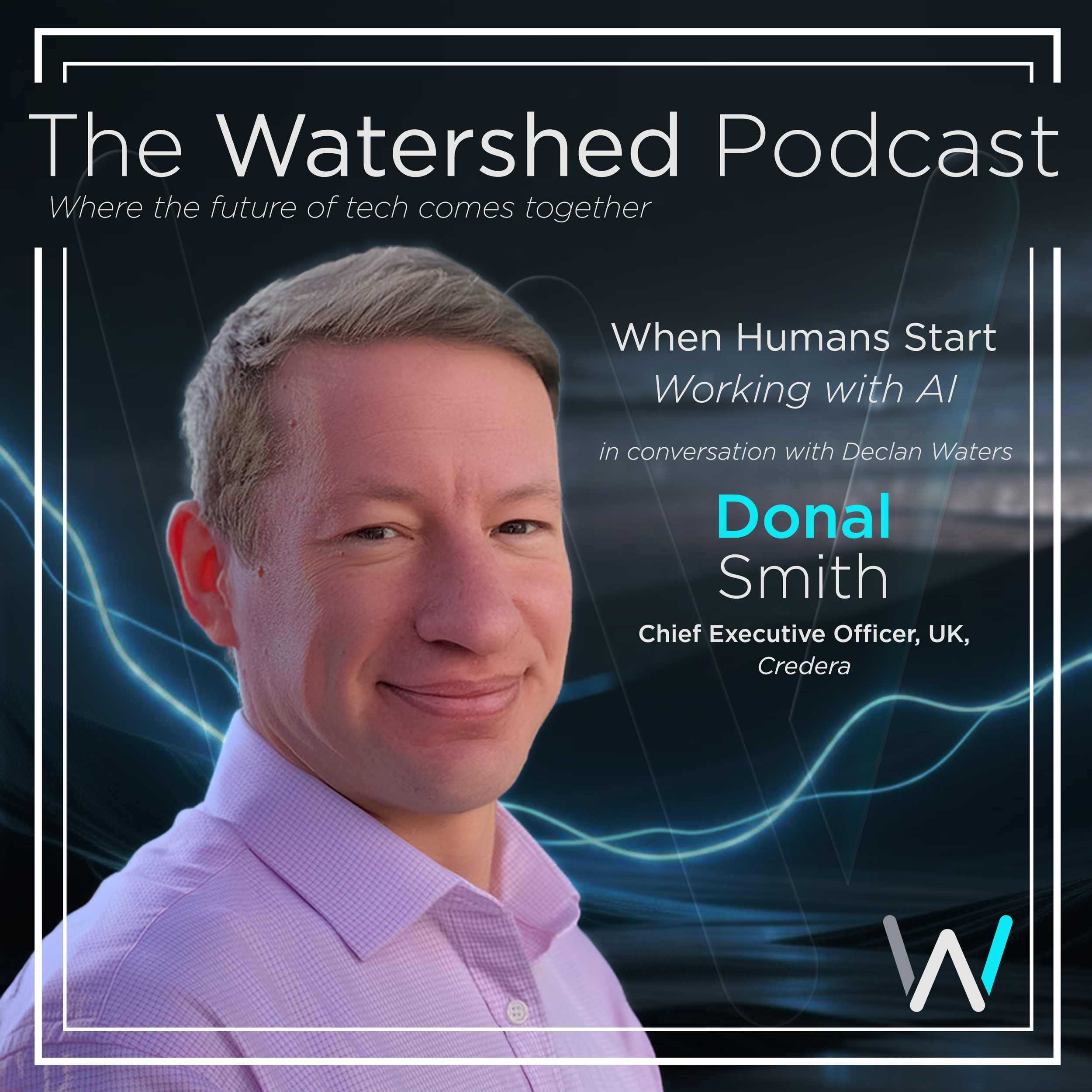
Hi everyone. I’m Declan Waters, Founder and CEO of Waters Agency, and welcome to The Watershed Podcast. Today, I’m delighted to be joined by Donal Smith. Donal is the UK CEO of Credera, a global consultancy working with large organizations on AI, data, and technology transformation at scale.
Donal, great to have you on.
Donal Smith (00:50)
Thank you, Declan. Good to see you again. This is a topic I’m really excited to talk about, so thanks for having me on.
Declan Waters (00:57)
I think we should let our listeners know that we’ve known each other since primary school, or elementary school depending on which side of the Atlantic you’re on. I can’t believe it’s been nearly 40 years. Where has the time gone?
Donal Smith (01:14)
We’re not that old, Declan. But yes, it has been a long time. Our friendship and personal lives have meandered in many ways, and it’s quite funny that we’re now sitting here together where our careers have essentially converged.
Whether it was AI that brought us here, or whether our career paths were always going to end up here, who knows. But it’s great to see you and have this conversation.
Declan Waters (01:40)
Absolutely. I’m really excited about this conversation. On this podcast, we’ll have a lot of technology vendors and companies joining us, but you have a very unique viewpoint on AI, cloud, and transformation from your position as CEO of Credera.
Before we talk about where things are heading, I want to ground us in reality. Almost every organization we speak to says they are “doing AI.” There’s a lot of activity and pilots, but very few examples of sustained, real change.
From your perspective inside large transformation programs, what do organizations usually mean when they say they’re doing AI?
Donal Smith (02:36)
That’s a great question. For most large organizations, whether in the private sector or public sector in the UK, AI has largely been about experimentation.
They’re learning what tools are available, how those tools might create value for customers or citizens, and how they might improve internal productivity. As a result, many proof-of-concept initiatives have spread across organizations.
Now the challenge is making sense of those experiments. Which ones worked? How do you scale them to production and enterprise level so the entire organization can adopt them and realize value?
The hype continues, and rightly so given the pace of change. But it’s also a scary place for C-suite executives. They’re asking how their marketplace, customer base, and business model will change. They need to understand that quickly and move forward, rather than wait for disruption to happen to them. If they wait, they may not exist in a few years.
Declan Waters (04:08)
What do those experiments actually look like?
Donal Smith (04:11)
They often start with a business problem. That could be entering a new market, developing a new product, or mitigating risk.
It might begin with an innovation workshop involving business leaders, identifying use cases where AI could help solve those problems. New AI technologies are then introduced to accelerate a proof of concept and test whether the idea can be delivered quickly and cost-effectively.
These experiments can happen anywhere in the organization, from internal productivity to customer-facing products and services. The challenge is deciding what to experiment with, because organizations don’t have unlimited time or budgets. They can’t stand still, but they also have to make difficult choices.
Declan Waters (05:20)
What’s the earliest signal that these experiments might fail? Are companies recognizing that early enough and pivoting?
Donal Smith (05:31)
I look at it slightly differently. Most of these technologies will work if applied correctly. The biggest successes are the ones that clearly move the P&L.
That could mean increasing revenue or market share, or reducing costs. The initiatives that deliver value quickly and with lower risk tend to succeed.
Failures often happen when projects become too complex or are disrupted before they even reach a real use case. Ultimately, the initiatives that generate real business value are the ones the finance teams are happiest with.
Declan Waters (06:26)
What’s interesting is that while experimentation struggled in 2023 and 2024, we’re now seeing massive investment from companies like Amazon, Google, and Microsoft. Huge capital expenditure on data centers, custom chips, and long-term bets.
It suggests we’re moving beyond experimentation into something more durable. From your perspective, working on multi-million-dollar transformation programs, what are you seeing?
Donal Smith (07:22)
We’re seeing organizations learn how to make these initiatives successful. Governance is critical, whether that’s ethical oversight, risk mitigation, or data privacy. There needs to be clarity around ownership. Who owns the technology? Who owns the business outcomes? When ownership is unclear, decisions slow down and progress stalls.
There’s also a human tension. AI can improve productivity, but it also raises concerns about job displacement. Employees worry about their future.
At the same time, organizations face external pressure from new entrants that can move faster, prototype rapidly, and disrupt established players. It’s a difficult balance, but organizations that get this right will experience extraordinary momentum.
Declan Waters (09:37)
You mentioned jobs and AI, which is a major concern in the media. What’s your perspective?
Donal Smith (09:55)
One area we focus on is inclusivity. Large language models are trained on vast amounts of historical data, much of which reflects male-dominated perspectives. That creates inherent bias.
At the same time, many of the roles most likely to be disrupted by AI are disproportionately held by women and ethnically diverse groups. If organizations adopt AI blindly, they risk amplifying existing inequalities. There are no perfect solutions, but organizations must understand how these models are developed and where they may have both positive and negative impacts.
Declan Waters (12:02)
You mentioned the idea of being “below the algorithm.” What does that mean?
Donal Smith (12:10)
Think of the algorithm as the AI itself. Consultants and leaders operate above the algorithm, designing processes, strategy, and orchestration. Below the algorithm are roles that are highly structured, measurable, and prompt-driven.
Those roles are more easily replaced by AI agents or automated workflows. The key question for organizations is who owns and orchestrates the algorithm, and who is most likely to be impacted by it.
Declan Waters (13:45)
One thing that feels different this time is that AI isn’t confined to IT teams. It cuts across operating models, cost centers, risk, and accountability. How do you see AI changing how the C-suite operates?
Donal Smith (14:31)
For CEOs, the role increasingly becomes one of chief storyteller. You need to explain what the organization is doing, why it matters, and how it will feel for employees as change happens.
COOs focus on risk, compliance, and integrating AI across siloed functions. CFOs evaluate investment returns and decide when to accelerate or stop initiatives.
Chief People Officers play a critical role in maintaining culture, developing talent, and preparing employees with the skills needed to operate above the algorithm. AI demands tighter collaboration across leadership teams. Alignment, communication, and clarity of purpose are more important than ever.
Declan Waters (18:11)
Have you been helping organizations figure out how AI should not be used?
Donal Smith (18:25)
Yes, particularly around data access. Some organizations hold sensitive citizen or customer data, and AI can unintentionally expose insights where access isn’t permitted. Understanding how AI reaches conclusions, who has access to outputs, and ensuring proper controls is critical, especially in regulated industries like government and finance.
Declan Waters (19:45)
Let’s move to my favorite part of the podcast. What’s been your watershed moment?
Donal Smith (20:13)
For me, it was realizing how quickly human-to-AI interaction is replacing human-to-human interaction in certain workflows. A senior engineer at Credera told me he no longer types prompts. He speaks to AI agents because typing is too slow. He’s orchestrating teams of agents delivering code and products in the background.
That was my watershed moment. It made me realize we’re entering a world where collaboration increasingly includes AI as a participant. Whether that’s exciting or scary is still an open question.
Declan Waters (21:40)
Looking ahead, what themes do you see emerging into 2026?
Donal Smith (22:19)
Consumer adoption of AI is far ahead of enterprise adoption. Around 80 percent of consumers use AI daily, while only about 10 percent of enterprises have truly adopted it. This year, enterprises will need to catch up quickly or risk disruption from faster-moving competitors. By 2026, I expect much broader enterprise adoption.
Declan Waters (23:33)
Where can listeners follow your work?
Donal Smith (23:59)
I’m on LinkedIn as Donal P. Smith. I’ll be sharing more thought leadership, attending events like CES, Anthropy, Cannes, and possibly Adobe Summit and AWS re:Invent.
Declan Waters (24:40)
Donal, thank you for joining us. It’s always a pleasure, and I’m looking forward to hearing more from you this year.
Donal Smith (25:02)
Great to see you. Thank you, Declan.
Declan Waters (25:04)
Thank you, Donal.