
Episode 3
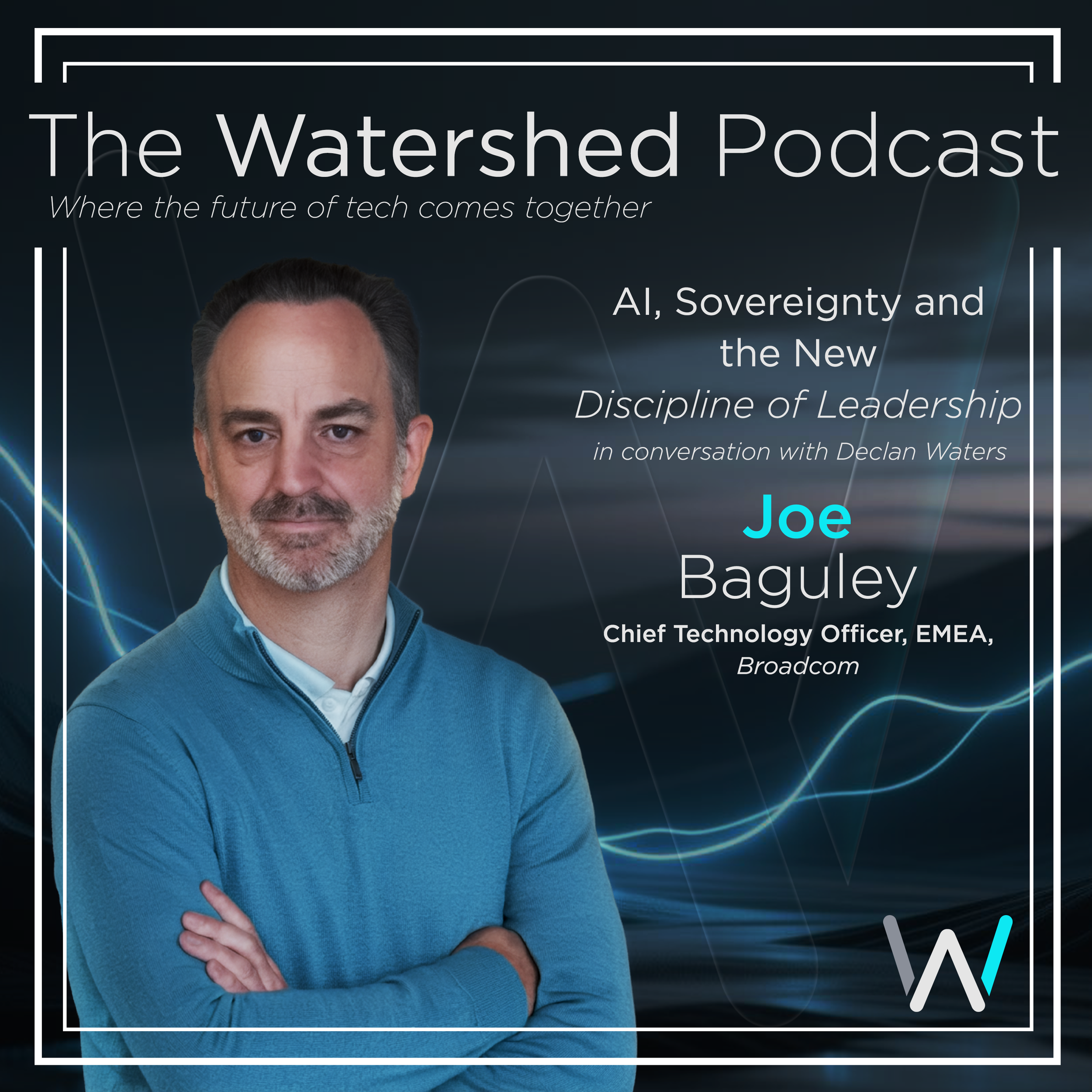
AI, Sovereignty and the New Discipline of Leadership
Key Takeaways
· AI is forcing enterprises to rethink infrastructure, particularly around private AI and on-prem inference.
· Adoption is accelerating faster than cloud because business leaders now feel direct pressure to implement AI.
· Most organizations are using AI for productivity and augmentation rather than full transformation.
· Hyperscaler infrastructure investment is real and substantial, but long-term projections may be exaggerated.
· Digital sovereignty is becoming a board-level priority, focused not only on data location but also operational control.
· Disciplined technology leadership requires pragmatism and the courage to resist hype.
· Long-term architecture thinking must extend beyond individual executive tenure.
· AI will become powerful when it becomes normal, embedded, and expected in everyday enterprise workflows.
Joe’s Watershed Moment
Joe’s defining watershed moment was joining VMware in 2011 and helping pioneer the Software Defined Data Center. At the time, it felt innovative but uncertain. Years later, he recognizes it as foundational technology that reshaped private cloud infrastructure globally and became an industry standard.
Full Transcript:
Declan Waters (00:03.353)
Hi everyone, I'm Declan Waters and welcome to The Watershed. Today I'm absolutely thrilled to be joined by Joe Baguley, CTO EMEA at Broadcom. I've been lucky enough to know Joe for many years and I'm delighted to have him on the podcast.
Joe is a recognized leader within the European community and is considered one of the world's most influential IT leaders. He was voted Top 10 CTO in EMEA in 2023 by Technology Magazine.
He speaks regularly at industry events, including The Economist Innovation Summit, and appears on major broadcast media such as BBC World and BBC Talking Business. He has also featured in Computer Weekly’s UK Tech 50 and Information Age’s Top 50 Data Leaders.
Joe, it’s great to have you on.
Joe (00:54.348)
Wow. My mum would be proud if she heard all that.
Declan Waters (00:56.813)
Quite the roll call. Brilliant, Joe, it’s great to have you here. As I said, we’ve known each other for many years and worked together in the press. I’m really interested in your perspective.
Let’s get straight into AI. From a structural shift perspective, does this feel like a Watershed moment for enterprise infrastructure?
Joe (01:28.902)
It does, mainly because people are realizing they’re going to have to approach infrastructure differently and rebuild infrastructure skills.
For a long time, the trend was commoditization. Put it in the cloud. Make it someone else’s problem. Don’t worry about infrastructure.
Now with AI, especially for large organizations, there’s a growing realization that they may need to run their own AI infrastructure. You hear a lot about private AI. Organizations don’t necessarily want their data in the public cloud.
Large enterprises and governments are recognizing they need to rebuild on-prem infrastructure to run inference on their own data, reduce risk, and often lower costs.
It’s interesting that AI is making people realize infrastructure matters again. Data centers matter, whether public cloud or on premises. It’s definitely a hot topic.
Declan Waters (02:33.381)
If we walked around an enterprise data centre today, would we actually see evidence of that transformation?
Joe (02:44.27)
You’d need ear defenders. Data centres are not silent.
To be honest, most people wouldn’t notice much difference. It’s still servers in racks with flashing lights. The difference is what’s inside them. We’re putting different accelerator cards in. The racks are denser. There’s more power per rack.
To an expert, the change is obvious. Compared to 15 or 20 years ago, it’s very different in terms of density and capability. But to most people, one set of flashing lights looks like another.
Declan Waters (03:24.943)
Cloud took over a decade to reshape enterprise infrastructure. Is AI on a similar timeline, or is it moving faster?
Joe (03:49.166)
Definitely faster. There’s no doubt about that.
Each hype cycle seems to compress compared to the last. We’re in 2026 now. Amazon EC2 launched twenty years ago, and organizations are still transitioning to cloud.
I don’t think we’ll be in a situation twenty years from now where companies are just starting to adopt AI. The disillusionment phase is happening faster. People are quickly realizing the limitations of LLMs.
Cloud was a fundamental shift. It challenged fifty years of how we built infrastructure. AI feels more tangible. Even people outside technology can see its potential and translate it into business value.
In the early days of cloud, CIOs were asking what they were doing about it. Today, business leaders are asking why they aren’t using AI yet. The buzz is wider and the adoption curve is faster. That creates a real challenge around education and awareness.
Declan Waters (05:35.365)
There’s a lot of capital moving into AI right now. How much of that is real conviction versus fear of being left behind?
Joe (05:53.816)
There is real conviction, especially from hyperscalers. You can see it in the stock prices of companies like Broadcom and Nvidia. Many of the top companies by market cap are now AI-driven.
There are real orders, real silicon, real infrastructure being deployed. It’s impacting the wider industry. RAM pricing, for example, is rising because so much supply is being directed towards AI.
Some long-term predictions are unrealistic, particularly around power requirements and data center expansion. But in the near term, the investment is real.
Enterprises are investing too, although access to hardware has been constrained because hyperscalers secured so much supply.
Two years ago, some organizations bought Nvidia equipment without a clear plan. Now the conversations are more mature. They’re focused on how to extract value and integrate it into the business. Some were burned by early investments, either financially or by inaccurate outputs.
Declan Waters (07:58.629)
How are organizations framing value and ROI from AI?
Joe (08:24.43)
It’s mostly about short-term productivity and human augmentation.
It’s not necessarily about job replacement. It’s about making individuals more productive. Doing more with less. Tools like Copilot and Gemini are central to that.
Organizations are starting to change internal workflows. Instead of spending hours compiling reports, someone can create a custom AI assistant to analyze enterprise data and provide insights quickly.
There have been cautionary tales as well. Some companies made decisions based on chatbot outputs that turned out to be incorrect.
At this stage, most enterprises are layering AI onto existing systems rather than fundamentally redesigning their business models. It feels similar to the early RPA phase. Agentic AI is often discussed in similar terms.
Declan Waters (10:04.185)
So AI is being layered onto existing systems rather than driving a full architectural rethink.
Joe (10:13.912)
Exactly. It’s about improving what already exists. Over time, that may lead to more fundamental shifts, but right now it’s incremental.
Declan Waters (10:58.127)
What other trends are you seeing?
Joe (11:12.494)
Sovereignty is a major one, particularly in Europe. Germany and France are leading a lot of those conversations.
Sovereignty has two aspects. First, where is the data stored and who controls it? Second, who controls access and availability? Can someone turn it off?
Legislation like the US Cloud Act and FISA 702 has prompted organizations to ask serious questions. Could external entities access or restrict their systems?
Organizations are asking how long they could operate independently if disconnected from the internet. These are realistic discussions driven by geopolitical uncertainty.
Declan Waters (13:27.333)
What does disciplined leadership look like in this environment?
Joe (13:53.518)
For me, disciplined leadership means pragmatism.
People assume a CTO should champion every new technology. In reality, the role often involves calming people down and introducing realism.
It’s easy to get swept up in hype. Disciplined leadership means protecting long-term architecture and avoiding unnecessary technical debt.
Executives often stay in roles for only a few years. They launch big projects and move on before dealing with the consequences. Real discipline requires thinking beyond your own tenure.
At Broadcom, we’re seeing more seven-year-plus private cloud deals. Organizations are recognizing the need for long-term architectural thinking.
Declan Waters (16:26.949)
How are you personally using AI?
Joe (16:46.536)
Mostly as a productivity assistant.
I run a highly automated home using Home Assistant. AI helps me write and understand code more efficiently.
I use it in spreadsheets and other tasks to achieve complex outcomes. It’s very much in a Copilot mode rather than a simple chatbot.
I also experiment with AI search tools, comparing results across platforms like ChatGPT, Grok and Claude.
I’ve even used conversational AI in the car as a learning tool. It allows me to explore topics hands-free while driving.
One idea that stuck with me came from Elon Musk. After asking a question, he said, “Was that the right question, or could I have asked a better one?” I often use AI in that way, asking how I could improve the question itself.
Declan Waters (19:36.451)
Does AI need to become normal before it becomes truly powerful?
Joe (19:42.862)
Yes. It needs to become accepted and embedded in daily life.
When something becomes standard, people expect it at work. They become frustrated if enterprise tools lag behind what they use personally. That’s when real adoption accelerates.
Declan Waters (20:58.597)
What has been your defining watershed moment?
Joe (21:23.31)
There are two.
The first was joining VMware in 2011 and working on what became the Software Defined Data Center. At the time, we didn’t fully realize how significant it would become. We defined categories like hyperconverged infrastructure and software-defined storage. Today, those concepts are industry standards.
Seeing that work power mission-critical systems, including British Navy aircraft carriers, is something I’m proud of.
The second moment was discovering I loved public speaking. Early in my career, I realized I gained energy from presenting and explaining complex ideas.
That shifted my trajectory. I invested in becoming a strong communicator. Whether speaking to twenty people or twenty-three thousand, there’s a sense of fulfilment when you connect with an audience.
Declan Waters (25:08.261)
Joe, I’m glad you’re still doing it. You’re one of the best speakers in this industry. I’ve seen you break down complex topics for both technical audiences and business leaders. You’re doing important work at Broadcom.
Joe (25:53.09)
It’s been great fun to be on. Thank you.
Declan Waters (25:56.355)
Thank you, Joe. Really appreciate it. Take care.