Episode 1
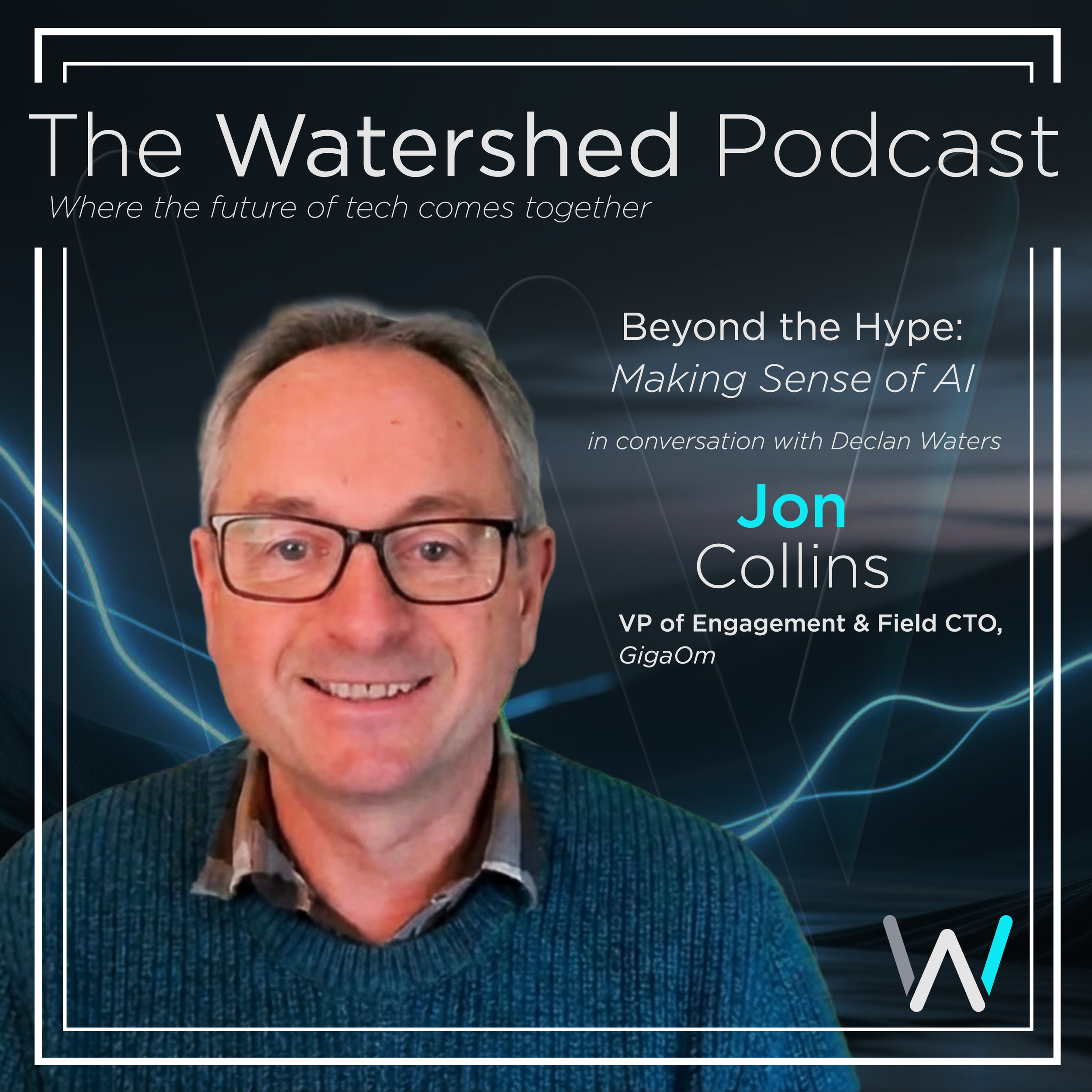
Beyond the Hype: Making Sense of AI with Jon Collins
Key Takeaways
· AI today is not artificial intelligence in the sci-fi sense. It is a powerful class of tools, particularly large language models, that are already disrupting how individuals and enterprises operate.
· The high failure rate of AI projects is not necessarily a sign of collapse. Early-stage failure is expected during experimentation, especially when organizations implement AI without a clear purpose.
· The shift now is from experimentation to execution. Organizations need to move from trying AI because it is fashionable to applying it with intent, governance, and measurable outcomes.
· AI governance is not only about risk. It is also about cost and efficiency. Without disciplined processes, organizations create duplication, lose track of models, and increase complexity, which drives avoidable cost.
· AI accelerates both progress and chaos. The same behaviours that created technical debt over months or years can now create it in days if teams generate systems quickly without maintainability or oversight.
· The people side is becoming more complex. Organizations risk damaging culture by removing staff too aggressively, especially the “glue people” who sit between teams and make collaboration work.
· The skills gap is widening. Skilled professionals can guide AI and judge output quality, while less experienced users may struggle to prompt effectively or validate results, creating an “augmentation gap” across the workforce.
· Long-term differentiation will come from creativity and innovation, not from replicating what everyone else can now produce faster. Automation will reduce the value of mundane work, making originality and value creation the key competitive advantage.
Full Transcript:
Declan Waters (00:04)
Hi everybody. I’m Declan Waters, Founder and CEO of Waters Agency, and welcome to the first episode of The Watershed Podcast. I’m absolutely thrilled to be joined by Jon Collins, an old friend of mine, and VP of Engagement and Field CTO at GigaOm.
Jon has spent decades at the sharp end of enterprise technology, from engineering and infrastructure through to cloud, DevOps, and now, of course, AI. He has one of the clearest lenses I know on how technology actually gets adopted inside organizations.
This is a relaxed conversation with Jon. No slides, no scripts, just a discussion and we’ll see where it takes us. Jon, I’m really pleased to have you on our first Watershed Podcast. How are you?
Jon Collins (00:57)
Thank you so much. Yeah, old friends. My goodness. It’s funny, when you know someone for 20 years, you realise, wow, we’re friends now. Literally. These are my people, so yes, very glad to be here.
Declan Waters (01:06)
Ha! Thank you, and it’s great to have you here. Yes, we go back a long way. I was saying to you before we started rolling that I still have your wonderful book, The Technology Garden, which you published in, what, 2005? Around that time?
Jon Collins (01:27)
Yeah, around that time. I’d have to check. We had a lot of fun writing that. It was myself, Dale Vile, Neil Ward-Dutton, and Neil McEaster. We were thinking, what are the things that make IT work? What are the things that help you harness massive complexity?
We ended up with something we obviously couldn’t call this, but it was basically the six habits of highly effective CIOs. I think it stood the test of time. There’s some really good material at the end too. Dale put together checklists of things to work through to embrace those habits, and those checklists are still amazing.
Declan Waters (02:16)
Yeah, absolutely. I’m going to dig it back up, and I’m sure a lot of what you talked about in the book will apply to what we’re discussing today.
Talking about going back a bit, you’ve had a varied and very successful career across enterprise tech, cloud, and DevOps. Looking back, what would you say was your personal watershed moment? The point where you could see how technology fundamentally changed, from your perspective.
Jon Collins (03:05)
Technology fundamentally changed for me, or for the world?
Declan Waters (03:08)
For you. From your perspective.
Jon Collins (03:34)
Okay. I was very lucky in my career. I started as a programmer at Philips Semiconductor at the time, programming catheter systems. I didn’t realise how well run that area was within Philips.
It was a quality-first environment. We had configuration management and a whole culture of doing things properly. It was only when I went to my next job at Alcatel in Paris that I saw how badly things could be done. I’m not saying everything at Alcatel was bad, but Philips had set the bar so high.
So, in the first five years of my career, I saw what very good looks like, because nothing is perfect, and then what normality is for many organizations. That set the scene.
From there, I worked for a consulting firm advising on agile processes, which is where DevOps came from. I worked for a software tools company on UML, helping with business processes and software architecture. So the first 10 years of my career were learning how to do it right, learning what happens if you don’t, and then helping other people do it. Then I became an analyst, but I’ve never lost that practical grounding.
Declan Waters (04:57)
I’m really interested to get into AI with you, Jon, because of all your experience and what you’re hearing in the industry. From your perspective and GigaOm’s perspective, how are you thinking about AI? You’ve lived through multiple tech cycles: client-server, internet, cloud, DevOps. Is AI genuinely different? And how are you feeling about the pace of innovation and the noise in the market right now?
Jon Collins (05:32)
I realised as I was talking that I didn’t actually get to my watershed moment, so we’ll come back to that, but I’ll answer your question first because it’s relevant.
AI as we see it right now, which is large language models, is not AI in the sci-fi sense. We’re not talking about cyborgs, robots, or post-singularity super brains. We’re definitely not there. We’ve arrived at some very, very useful tools.
They’re massively disruptive. We see it everywhere. Parents can now write legal letters to schools in minutes, and schools are wading through long complaints. People are making music by ripping off artists, and artists are understandably upset. Everyone is dabbling with these tools. Enterprises are trying to figure out how to use them.
In tech, there are two dimensions. Take a company like F5 Networks. They talk about networking for AI and AI for networking. Networking for AI is making sure the data gets where it needs to be so you can build models, train them, and run inference. That’s having a huge impact on data center architecture. I’ve spoken to Cisco about it as well.
Then AI for networking is applying language models to break-fix, event management, noise reduction, diagnosing problems, and fixing them. And that’s true across infrastructure, operations, cybersecurity, ransomware protection, you name it.
Every company we speak to, whether it’s a car manufacturer, a bank, or a hospital, is asking: what do we do with AI? So yes, it’s hugely disruptive.
Declan Waters (08:12)
When you talk about companies rolling out AI, a lot of people saw that MIT study saying something like 90 percent of AI projects are failing. When you look at experimentation versus real systems, where do companies tend to fall down when moving from experimentation to something that sticks and gets into production?
Jon Collins (09:01)
This is where my watershed moment starts creeping in. It’s a great question.
This wave of LLMs has been two years now, since ChatGPT appeared and everything changed. A year ago people were deep in it, and we were saying: treat this as the experiment phase. Don’t worry about it.
I’m not skeptical of the 90 percent figure. Things shouldn’t be working yet. People should be trying stuff and seeing what sticks. Experiments shouldn’t always succeed. If they always succeed, they’re not experiments.
There’s also been pressure from leadership. I remember a CIO saying his bosses told him: “We need some AI. When can we have it?” He asked: “For what?” They replied: “Don’t care. We need it in the annual report.” If you’re building something with no purpose, it won’t succeed.
But we’re transitioning now. Playtime is over. We need to apply AI properly and deliver value rather than just proving we can do something.
Declan Waters (11:34)
We’re hearing a lot from Waters Agency clients about governance. What are you hearing in terms of governance and trusting these systems in an enterprise context?
Jon Collins (12:11)
You said this was unscripted, but that would have been my next point. It’s almost like we know each other.
Ultimately, it comes down to three things. First, doing things right. Second, doing the right thing. Third, building on a foundation for success.
I learned this back in the 90s in a technology strategy group. A consultant I worked with, Roger Davis, had a simple way of describing it. He said there are only two things a company needs to do: doing things right and doing the right thing.
Doing things right is being efficient in how you deliver. Doing the right thing is making sure what you’re delivering is actually valuable.
When you talk about AI governance, you need both. If you build AI chaotically, you take three times as long and it costs three times as much. So you want good process. For example, configuration management for models matters. You don’t want to create 50 models and then forget which one worked. You need the pipeline from model to results. You need quality controls.
With AI you also have explainability and trust questions. You need to know you’re not building systems that hallucinate. If you ignore structure, process, and quality, you just create more cost.
People rush because they think speed is everything, but you can go fast if you prepare properly. Fail to prepare, prepare to fail.
The trouble with AI is that it accelerates outcomes, good and bad. Historically, humans slowed problems down. With AI, you can generate hundreds of applications quickly, and then you don’t know what they do or how to maintain them. AI accelerates its own demise if you do it wrong.
Declan Waters (17:46)
I want your take on the people, culture, and skills side of AI. It makes me think about The Technology Garden again. How much is the people challenge factoring in right now, and where do you see that going?
Jon Collins (19:09)
We’re running over the cliff a bit. We assume it will all be fine, even while we do some very stupid things. That’s human optimism, but it’s dangerous.
On skills, jobs will change. Some roles will evolve, some will go away, and new ones will appear. But some organizations respond by cutting people to save money. That’s tactical, but it can rip out corporate culture.
There’s an old book called Peopleware by Tom DeMarco and Timothy Lister. It talks about what I’d call glue people, those who sit between departments and make things work better. If you remove them without thinking, things work less well and you create cost.
We also have what I call the augmentation gap. Skilled people can use tools like Claude, Gemini, or ChatGPT to write software or solve problems and can tell whether the output is good. Less skilled people often can’t prompt effectively and can’t judge the quality.
If you don’t have discernment, you may accept outputs that work today but break later, or you get stuck when they fail. Organizations need to think hard about skills mix. Junior staff should become drivers of augmented ways of working, not passengers. If you remove them entirely, you have no future.
There’s also a distinction between art and craft. Art is a fundamental human need. It won’t go away. The craft, how we execute, will change. In the enterprise world, creative skills become more vital because we won’t be held back by delivery capability. We’ll be held back by innovation. Automate the boring stuff, but replace it with creative work that gives people room to contribute and differentiate.
Declan Waters (25:01)
Given the cycles you’ve seen, what advice would you give a founder or an enterprise leader? What mindset should they double down on as we move into an AI-first world?
Jon Collins (25:26)
Every business needs to think about value. Value is benefits minus costs.
Costs come from inefficiency, doing things wrong. Benefits come from doing the right thing. What can you deliver that customers value? What differentiates you? What can you do that people need, that you can monetize, that others aren’t doing well?
A lot of AI projects will just replicate what everyone else is doing. You need to focus on where your future differentiation comes from, in a world where the mundane becomes less and less of a business model.
Declan Waters (27:13)
What’s exciting you personally right now? Trends, companies, anything catching your eye?
Jon Collins (27:41)
The excitement is seeing people who get it using these capabilities to achieve things that were previously inaccessible.
A lot of these algorithms have existed for decades. In the past they required expensive supercomputers. Now they can run on a phone. It’s less about achievability and more about accessibility.
But the same thing that excites me also concerns me. Kranzberg’s law says technology is neither good nor evil, nor is it neutral. If you give huge power to the wrong hands for the wrong reasons, you get the wrong results.
There are risks, like echo chambers and influence in social media. With AI, there are risks too. But there are also extraordinary opportunities. Think about diagnosing complex illnesses faster with limited equipment. I judge the Mobile World Congress Global Mobile Awards in healthcare, and seeing the ability to get equipment and support to people remotely is incredible.
Using technology to help people live better lives is what excites me most.
Declan Waters (30:54)
Final reflections. If we come back in three to five years and record another episode, what do you think we’ll say the real impact of AI has been?
Jon Collins (31:43)
It’s interesting to reflect on what won’t be the impact.
This is the latest in a series of automation waves. It will have a profound impact. Cloud changed how businesses build IT, but it didn’t change everyday life for most people. The web did. Enterprise applications did.
This is the biggest change since the web in terms of how we go about things. But what it won’t change is our need to interact. When ebooks arrived, people said books were over. Instead, more people read. Vinyl has returned because humans like physical connection.
AI won’t remove our need for human contact. You might get a robot haircut one day, but I’ll still go to the barber because I like the chat. We’ll still go to gigs. We’ll still read books written by people because we want to know about the people who wrote them.
Declan Waters (33:54)
Jon, this has been a fantastic conversation. I really hope you never change. You’re one of the good guys in this industry. It’s great to call you a friend and colleague, and I’m thankful you came onto our first Watershed Podcast.
Before I let you go, can we finally get to that watershed moment for Jon Collins?
Jon Collins (34:57)
Yes. It comes back to value: benefits minus costs.
There was a time before I realised that as an individual, it’s about what I bring and how I do it. And as a company, it’s about what it brings and how it does it. Everything else is secondary.
If you focus on removing the cost of delivery and delivering the right thing, you need to think about very little else. Not thinking about it causes many problems. Writing a book, running a marketing campaign, selling, volunteering, whatever it is, you’ll do it better if you keep that in mind. That’s why it’s watershed for me, and I hope it’s helpful to others.
Declan Waters (36:18)
For people who want to follow your work, where should they go for your writing and GigaOm?
Jon Collins (36:33)
GigaOm.com is always open, doors always open to conversations. Find me on LinkedIn, Jon O. Collins is probably best for this audience. But yes, just reach out. I’m not hard to find. Always open to talking about this sort of stuff.
Declan Waters (36:56)
Always got an open door. Jon, thank you very much for joining me on The Watershed.
Jon Collins (37:02)
It’s been a pleasure. Thank you, Declan.
Declan Waters (37:03)
Thank you, Jon.