
Episode 6
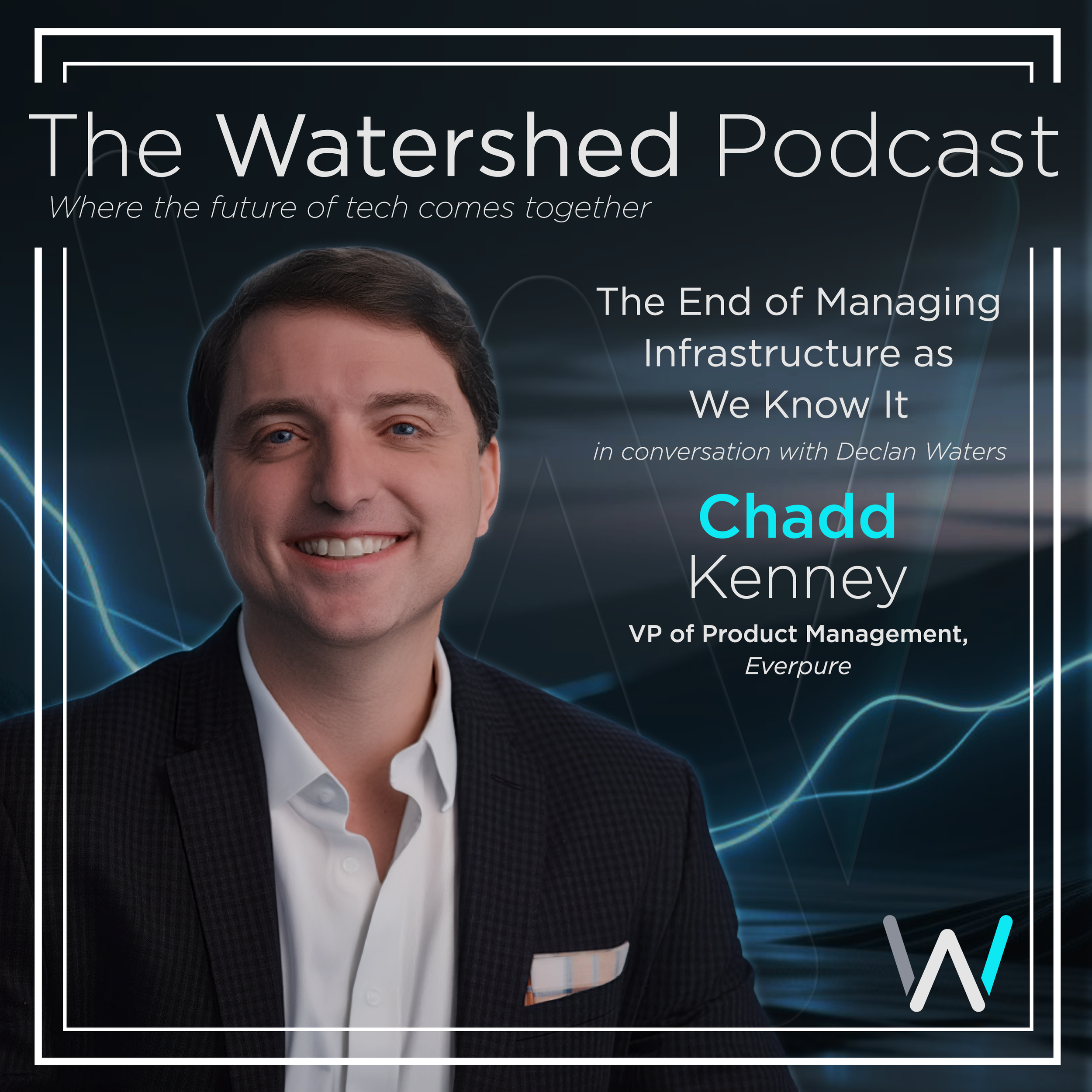
The End of Managing Infrastructure as We Know It
Key Takeaways
The future of enterprise infrastructure is shifting from products to platforms.
AI success depends on access to unified, real-time data rather than isolated copies.
Data silos remain one of the biggest barriers to innovation.
Organizations must move toward intent-based infrastructure driven by policy and outcomes.
Timing and product-market fit are critical to startup success.
Customers are increasingly looking for outcomes rather than standalone tools.
Partnership ecosystems are essential for delivering scalable AI platforms.
Chadd’s Watershed Moment
Chadd’s defining watershed moment was the shift from building products to building platforms.
Throughout his career, he focused on creating better technology solutions. Over time, he realised that customers were no longer looking for incremental improvements. They wanted outcomes delivered with minimal complexity.
This led to a fundamental change in perspective. Instead of managing infrastructure, organisations want systems that operate autonomously based on intent.
This shift reshaped how Chadd approaches product strategy and reflects a broader industry transformation toward platform-driven thinking
Full Transcript:
Declan Waters (00:02.107)
Hello everybody, my name is Declan Waters and welcome to The Watershed. Today I am thrilled to have Chadd Kenney with me. Chadd is a VP of product management at Everpure, the company formerly known as Pure Storage, which just completed a full rebrand two months ago, which I’m sure you’ll know unless you’ve been living under a rock. Chadd has been part of that story since almost the beginning, joining the founding technical team when there were fewer than just 10 people in the room.
With a bold idea about flash storage. Since then, he’s held just about every senior product and technology role the company has created. In between, he left to run a few startups, VP of product at Clumio and then the COO at Blue Sky, before returning to Everpure to lead product strategy, growth, and monetization across the platform. He’s a technology leader who knows how to tell a story, and I know that because I’ve worked closely with Chadd at Clumio and also at Pure.
So delighted to have you on the podcast. So welcome.
Chadd Kenney (01:03.63)
Yeah, excited to be here. Thanks so much for having me.
Declan Waters (01:06.043)
Thank you, Chadd. So less than 10 people in the room, and now you’ve got thousands at the SKO. I saw that post on LinkedIn just recently with you on stage. How does that feel, being on the inside from just those small beginnings and now being part of this huge story that you’re part of?
Chadd Kenney (01:26.862)
Yeah, it’s been a blast. Actually, probably some of my fondest memories in tech have been in the early days. So I joined Pure at about 40 or 50 people. There were about 10 people in the room when we were at our first sales kickoff, which actually was about nine months in. And wow, it’s spectacular to see a couple of different things. One is, I think from being inside and then outside of Pure, it gave me good perspective on a whole slew of things, which I’m sure we’ll go through.
We had all the right recipes, I think, from the very beginning. And so it was really, really amazing to see that recipe play out in the market. And the learnings, both on just massive escape velocity that we were able to achieve very early on, have just been kind of the ride of a lifetime. I enjoyed every moment of it, and it was an absolute blast.
Declan Waters (02:19.547)
Was it one of the best SKAs you've been to? And if so, why do you think it wasn't?
Chadd Kenney (02:21.836)
Yeah, so they’re all a little bit different, right? It’s like one of these super earliest of days. I think it was almost frightening. I had come right from EMC. It was a massive company that was very process-oriented. And I call it my military career, where it was very regimented to effectively free-form, right? You had to come up with all this stuff yourself. And so the first SKO was killer because we were just trying to figure out what we would even tell customers.
I was asked by Matt Burr, who was running sales at the time, to get in front of some of the folks and the board to show our first whiteboard. Yeah. I’d always loved telling stories, but I was still just trying to even learn the space, let alone the technology and this, that, and the other thing. And maybe that’s why they asked me, but the model was interesting to really try to come up with.
At sales kickoff, we unveiled this first whiteboard, which really went after the core areas that we focused our storyline on in the future. It was performance, efficiency, reliability, and simplicity. And simplicity actually probably being one of the key capabilities of it. But really being able to tell a story of the why of Pure. That really continued to be a really fun thing to kick off SKO. And then every single SKO has been a little bit of an evolution of that message, to be honest. And this year I was up on stage, furthering the evolution of that.
So it’s been just a blast being back and obviously helping to drive transformation in the company, as well as with our customers.
Declan Waters (03:58.266)
Yeah, let’s talk, let me touch on that. The why of Pure. So, and the rebrand and everything that came with that Everpure. It was huge news when it came out. My LinkedIn feed just blew up. It was all Pure for quite a few, quite a few days after you made that announcement. Maybe just take us through the what, why, why the brand change. Why now?
Chadd Kenney (04:23.214)
Yeah, great question. So if you think about where we started as a company, we built an all-flash array. Our original kind of pitch was, you know, all flash at the price of disk. We really honed in on making a much simpler solution that drove great efficiencies and really was maybe a more software-oriented approach to what was traditionally a very hardware-oriented play. And I’d say we built the best solution for storage in the market within the box itself.
I think what we had started to see, you know, customers holistically think about was it’s not just about storage systems, because storage systems were actually somewhat of a limiting factor in certain environments. If you think about the way things evolved, it was applications needed to be deployed. Someone went and bought a storage system, and then that application was tied to that storage system. And it became effectively a data silo of that information.
As things went on over time, you had more and more of these silos built out for more and more of the applications that were deployed. And you effectively were kind of increasing complexity as you scaled, as well as it was harder and harder to even understand what data that you had. Comically enough, we tried to do some different ways of what we’re kind of seeing a replay in AI today. If you think about data warehousing or the data lake, it was trying to take all of the silos of data and throw it all into one location so that you could finally actually rationalize and understand what it was.
So people have been kind of attempting to simplify the way that they were looking at their data for a long time. And we’d kind of seen that evolution play out. And so that’s really what started the brand evolution. We wanted to get more into helping customers be able to manage their data and not their storage systems. And so the evolution for us was that we needed to start thinking about technology solutions that went beyond the box, right?
We did really killer at building a very simplified storage system, but we needed to help them transform from a product to a platform. And that platform would allow them to abstract away the infrastructure and actually holistically understand their data better. And so as we’re going through this transition, we realized that we were not a storage company really anymore. We were a data company.
And as we started to think about that, like we started to look at, you know, there are some core aspects that we really, really love about Pure. And so we wanted to keep that part of the name. In fact, I’d say it kind of still gets down to Pure. You’ll probably hear me say that. So having the Everpure thing quite nailed yet, but Evergreen was kind of like both our architectural approach and consumption model. That was one of the things our customers absolutely loved the best about us. And I think when we paired these two together, we started to rationalize that we could build an Evergreen, more data-centric thought process with our customer by kind of changing our persona away from storage a bit.
We’re still there. We’re still building storage solutions, but we’re evolving very quickly towards data management capabilities. And I think in a world of AI, it’s perfectly timed because you kind of get into a world now where it’s like we can continue down the same path, let’s create another silo for AI, or we could start rationalizing our data and really start to build things like a semantics layer and understand data ontology and get a knowledge map of all the data.
And allow agents and analytics and new applications that we develop to consume that information holistically, whether it’s on Pure or anything else. So we just realized it was a moment in time that was a great opportunity for us to transition the company, as well as transition the brand on how we’re seen outside.
Declan Waters (07:52.86)
That’s great, Chadd, very interesting. So if I’ve got this right, Everpure’s bet going forward is that the enterprise AI problem is a data management issue as opposed to a model or a compute problem.
Chadd Kenney (08:07.064)
Yeah, and I think data management holistically solves a series of fundamental problems, right? It solves security issues. Things like ransomware or exfiltration events typically happen from data that people didn’t even realize they had or weren’t rationalizing their data state holistically. It was like a copy of data, some piece of data somebody had created, and they forgot it existed, and somebody had just been exfiltrating that data out of the environment.
So part of this is starting to rationalize data in a new abstraction or a new construct. And I think what we’ve been doing forever is looking at storage resources, things like volumes and file systems and buckets, just like that’s what traditional infrastructure folks thought about, right? But when you think about data, they think about the entities of data, and they track the ontology, and they understand the knowledge map of how the pieces of that data interconnect with each other.
We’re going to do the exact same thing from the infrastructure stack, where we start building new constructs that are not associated with your traditional storage resources. They now have things like policy and SLA and context associated with these data objects. And that allows consumers to start building intent-based infrastructure or autonomous infrastructure, where you just apply policy and you say, “Hey, here’s how I want it to be delivered,” and the infrastructure goes off and delivers it based upon what you’ve requested.
I use kind of like this fun analogy because it’s easier for people to understand, but can you imagine going into a restaurant, the best burger restaurant you can think of, and walk in and say, “Hey, I want this burger,” and it’s got to have a bun and some aioli, then some cheese and a patty and another cheese and a patty, and then I want a pickle, and I want to make sure there’s a good rounding of pickles, and then I want another bun under that?
No, you walk in and say you want the double smash burger, whatever it may be, right? You just say what you want, and it gets delivered as such. So if you think about that kind of model, what enterprises need to do is be able to say, have policies or service levels, and I want to apply that to data. And I have an expectation that you as an infrastructure are going to deliver upon that. And that’s a big change in the way that we’ve been managing storage in the past.
Chadd Kenney (10:18.722)
You know, managing storage in the past. It’s a platform motion. It’s not just a storage array that provides feature functionality. It’s actually an entire platform that provides policy and intent and execution.
Declan Waters (10:30.843)
That’s interesting, Chadd. I love that analogy. That’s one of the reasons why you’re such a good storyteller. I think we need stories like that to help us understand what’s going on out there at the moment. Needless to say, every vendor right now has an AI story. Help us understand, from a CIO perspective, what they should be asking before they’re signing these multi-million dollar contracts.
Tracks now, because Pure is going to be one of the companies that they’re looking at from a data management perspective. How is Everpure, and I have to remind myself as well to use the right brand name, what should CIOs be thinking about when they’re looking at?
Chadd Kenney (11:14.722)
Yeah, so let’s talk a little bit about just kind of the evolution of what we’re seeing in the market today. So if you look at where the bulk of the growth of, let’s say, GPUs and infrastructure associated to AI, it had mostly been at the hyperscale, as well as neo clouds, people providing GPU as a service.
We built a new product that we announced, what was it, last year, FlashBlade XA, that effectively was this ultra-scale product because people were looking for tens of terabytes per second, which was just somewhat unheard of that was out there. And so we kind of attached ourselves now to that market and really trying to help model builders or people who are doing AI at scale to be able to have an infrastructure solution.
We’ve obviously been doing a lot with hyperscalers as well. And so we’ve been able to kind of get the learnings from ultra hyperscale to bring that back to enterprises as well.
I think what you’re going to start to see in the enterprise is the biggest barrier to success is fundamentally understanding and rationalizing the data that you have. If you think about where AI excels, agents effectively need to be able to understand and be able to get access to the data that’s relevant to whatever they’re inferring.
And we’re doing so, you can’t just have a new pool of data that you’ve copied to some other location because typically they want access to real-time transactional information in the enterprise. And so if it’s a copy, it’s old based upon the fact that it’s a copy. It’s not like the traditional data itself.
The second big part is that you need to actually be able to rationalize all of your data, not just the ones on-prem, not just the ones in the cloud, not just SaaS as a whole. You’ve got to understand all of it. And if you think about the way that the market’s pretty much been going after it, it’s like, if you’re a SaaS solution, you have your own AI facilities within it, and they want you to bring more of your data to them so that you can correlate the data.
If you’re on-prem, they want you to create a whole new copy, which is old and latent and doesn’t have all the data that you need. If you’re in the cloud, you’re trying to consolidate much of the information there. What really is needed is actually to build a new substrate that agents can consume. And that’s effectively your semantics layer, your knowledge graph to understand all data.
And this is really the area where I think you’re going to see us excel quite a bit. The first part is that we build a unified data plane and infrastructure on-prem for your most critical data. So we simplify that environment quite dramatically. We built this intelligent control plane that allows you to be able to rationalize policies, that intent that I talked about.
The next big thing is building in this semantics layer. And that semantics layer gives you the ability of being able to understand data ontology, data sensitivity.
Chadd Kenney (13:52.238)
Your knowledge map across all of the datasets, but not just do it for Pure, do it across all of the environment. And then from there, once you’ve now rationalized and understand your data, you can start using some of these foundation models for particular use cases or agent deployments for specific types of tasks, and then be able to scale that to any size environment.
But the killer part here is that we’re building an infrastructure that actually can have AI running on top of production data, not having to create an entirely separate copy of it. And so I think the benefits of this is that we give this new substrate with this great control plane that sits below it.
And now agents, analytical environments, and even next-gen applications have access to that common data layer, which is going to be the biggest barrier for people to get these AI products off the ground.
Declan Waters (14:41.787)
That’s interesting, Chadd. What does the ecosystem look like for Everpure to be able to deliver that? I’ve noticed you made an acquisition recently with, I think it was OneTouch. I think that was Q2. You made that acquisition. I’ve also seen the partnership, which went GA, I think in 2025, with my old employer Nutanix, which was a very interesting one as well. What does the ecosystem look like going forward for Everpure to be able to deliver that?
Because you are solving some big problems here. So what does that look like?
Chadd Kenney (15:17.71)
Yeah, I’d say our biggest partnership obviously is with Nvidia. We do quite a bit of work with them in just building this platform. People are relying upon them for compute in order to actually run these types of models, mostly for inference at this point, I’d say. And the neo clouds are seeing a lot more model training, a lot more inference on-prem, and, of course, data processing to get data in order for it to be viable for various different types of workloads. So Nvidia, number one.
I’m starting to see a much more holistic view in virtualization, but I’ll table that for one second. I’d say other ones that we’re kind of getting into further, OneTouch was an acquisition to help us build that semantics layer. It’s a killer company that goes off and dynamically discovers all of your different data sources across SaaS and databases so that you can really be able to understand data holistically.
And then be able to provide that knowledge map so that people can understand how data intercorrelates with each other. And it applies to us for multiple different use cases, things like ransomware. If you think about storage infrastructure, it typically has a heuristics-based understanding of things. Data change rates change, maybe performance changes, overrides happen faster, but data classification in the actual data layer itself provides a much deeper version of understanding of that data.
And so pairing these two together, the infrastructure heuristics and policy with the data management capabilities, gives you a lot of power. We kind of call it this thing called super context. It’s context across both of these together, providing some superpowers on the infrastructure side.
The virtualization side of the house, it’s quite interesting. We kind of went through this evolution of needing to make a more efficient way of doing virtualization. I think Nutanix went after that with an HCI-type version of things, where you could kind of pair compute, networking, and a hypervisor together. We saw this rationalization now of kind of moving towards Kubernetes.
And I think what we’re now seeing in the market is much more of a platform-centric view. It isn’t just a matter of virtualization anymore. It’s a matter of, do I use this platform to do AI, to do my business-critical applications, to do my XYZ. And so it becomes much more of a platform story than just trying to solve where my VMs land. It’s actually much more strategic than that.
I think as we started to rationalize this shift in the market, we started to look at new partners out there. And so Nutanix, as an example, at scale, saw an opportunity to partner with us in a disaggregated configuration, where they were able to use very high-performance storage, such as Pure Storage FlashArray in particular, and attach this to an environment that scales compute very, very linearly and nicely, and becomes a great partnership for efficiency for customers at scale.
And so we’ve been having a lot of success with that team and are excited about this partnership, especially with helping customers be able to build that platform for AI, build that platform for next-generation applications.
And at the same time, an alternate option to the traditional Broadcom solution that’s out there. Many people are looking for various different options that are just beyond the existing environment that they know so well and find their way into great products such as Nutanix, as well as other ones that are out there.
Declan Waters (18:42.681)
Yeah. Chadd, you’ve given us really great insights into the Everpure rebrand, the huge problems that Everpure is trying to solve in the market, how you’re simplifying that. You’ve given us the CIO perspective, you’ve given us the AI thesis and ecosystem information, which is fantastic. I want to just bring this back to you a bit now as well, if that’s okay, and just touch briefly on the kind of when you left Pure to go to Clumio and to Blue Sky, you went into the startup world.
What do you think the startup years gave you that have changed how you think about your job now, coming back to Everpure? What were the insights there that you might be able to share?
Chadd Kenney (19:29.998)
I’ll share some of the painful insights, I’d say, more than to start with, and then I’ll get into the more positive ones. I think what was interesting is I took kind of like, when I looked at Pure, it was like we got to product-market fit perceivably while I was here pretty easily. Escape velocity, ultra scale, it looked pretty damn easy, to be honest. There was definitely a grind at the beginning and lots of challenges to try to figure out how we were going to build better products, but it seemed like it was easier.
And maybe that was just the roles that I was in, but when I got on the outside and tried to build companies, it was not as easy as it had looked. And I think there were a few interesting learnings that came about.
I think the first one is that our founder had a very, very unique model of keeping tight to the vision. He believes that everyone else has it wrong and that we had it right, and stuck to it. And I think that was probably one of the bigger wins. He’s still here today. I love working with him. He’s one of my favorite bosses I’ve ever had, as well as a friend. He’s just been hyper-focused on simplicity, for one, and building really unique technology approaches to deliver the solutions that we do.
The second big part is timing. I’d say that that’s a big issue in most startups. If you start too early, it takes you a lot of time to get awareness of the problem enough to get people to want to buy the solution. If you’re too late, you’re always trying to rationalize why somebody else is different than you.
I think that was one of the big parts that Pure did so successfully that is always challenging in startups, figuring out exactly what the timing looks like.
And then I’d say the last one is, if you look at the solutions we were building at the time in certain ones of these, customers hadn’t rationalized the problem well enough. It was partially timing. So at Clumio, as an example, there weren’t a lot of ransomware attacks or there wasn’t massive data loss in the cloud quite yet. And so that timing was important to really be able to nail that this is a big problem and I’ve got a great solution to solve it.
Sometimes it was us telling them that the problem exists. Comically enough, people used to tell me that they thought the cloud protected its own data. Why the hell would I need backup?
So that was definitely one. The rest of the startup time for me and learnings was kind of a bit of just trying to feel what it feels like to sit in a room with two to three people starting a company fresh. And Blue Sky was definitely that. I got to kind of see from the smallest of environments, just two people in a room, all the way out to within nine months getting to one and a half million in revenue and building out a go-to-market team and building a product that helped customers out.
I think for me, coming back to Pure now, I’ve taken much of the learnings that I’ve gotten on the outside and my transformation to much more of an operator than kind of just a lone soldier, in a certain sense. I think the startup world really forces you to get into operator mode quickly. And as I’ve come back to Pure, I’ve definitely changed that mindset quite a bit.
It’s also helped me be able to rationalize a little bit about what customers need in order to actually buy products. And so I’m much harsher now on things like, should we build something in this space based upon the problems that they have, from learnings at Clumio, where it was like the problem wasn’t big enough in certain situations quite yet. Now it’s obvious, but back then not so much.
And really be tight on where we invest our dollars in engineering today on whether we actually have a solution to a problem a customer is willing to buy a product for. And if not, and if the timing’s too early, we need to rationalize that. And I think I didn’t have as much of that perspective in the early days, and the world of startups gave me lots of new perspectives that I never had.
Declan Waters (23:29.491)
Very interesting, Chadd. Yes. Well, timing is everything in life, isn’t it? And that leads me on to my last question, which is the question I love to ask all of our guests. And of course, I can’t let you get away, Chadd, without asking it, because it is the title of our podcast, The Watershed.
And so what would you say, you’ve had a long, distinguished career, which is still going strong, but what would you say is maybe a decision or a conversation or even perhaps a realization where everything changed for you in your career? Can you pinpoint one thing? Or it could be more, actually, but what springs to mind there?
Chadd Kenney (24:05.678)
Comically enough, there’s a bunch of them. I’d say the one that’s most relevant. I feel like I’m kind of in the mode of today. As you start to think about it, I’ve been in infrastructure for quite some time.
And I think as you look at building great products, sometimes you get stuck into, I’m going to just build a better and better product and continue to make that amazing. And sometimes you miss the whole model of the fact that customers are looking for something very different.
And I think the world shifted, especially with AI, into something that needed to happen differently. And so this whole change between products and transitioning to platforms has been my watershed moment. It’s actually started to make me rationalize how difficult it is, both internally and externally, to get people to rationalize this type of thing.
And what’s great is it’s driven by customers. So customers get it. They love the fact that they’re not managing systems anymore. They’re managing one common platform with policy and service levels and effectively intent.
I kind of look at it as a moment where, maybe it was this thought process that I had, and maybe I hope that my kids don’t actually drive their cars and cars are fully autonomous. But think about a world, real quickly, where all cars are autonomous for a quick second.
Declan Waters (25:24.847)
Mm-hmm.
Chadd Kenney (25:25.014)
Now today we have this mixed bag, and I think that makes this somewhat problematic, right? Your car drives autonomously, but you still have to deal with people who are not. And so you always have the worry of somebody intervening or causing issues within that.
But when you get to a world where everything is autonomously driven, now a lot of things change. There is no traffic, right? Because the car has effectively managed the infrastructure in the most effectively.
You can spend more time thinking and being productive in the car versus being stressed and trying to figure out how I’m going to get to work on time. You know exactly what time you’re going to get to work. There’s not a fear of bad things happening in a vehicle.
The car effectively is just this autonomous thing that takes off. And so the value proposition of this abstraction away from me managing a vehicle to me just getting to a location is incredibly powerful, because all I do is say my intent is to be at this location at this time. And it tells me when I need to get in the vehicle to get there.
There’s no variability associated to it. And so if you think about that in an infrastructure approach, how powerful is it for you to be able to say, I’m going to deploy this workload, whatever it may be, and here’s my SLA I want you to deliver upon. Here’s the policy I want to ensure always happens. And you figure out what to do with it.
And it goes off and does its own thing to be able to figure out how I deliver the SLA, how I ensure the data is protected. And then with context, allows me to be able to understand where that data resides. How secure is it? Where are other copies that exist? A bunch of really killer things that don’t require people management, just like it doesn’t require you to drive the car.
The car drives itself, and there’s so much power to that, just like the data infrastructure drives itself. And there’s a lot of power for enterprises for that as well.
Declan Waters (27:06.275)
So much to look forward to, isn’t there, going forward? I mean, can you remember an exciting time like this in technology where everything’s going?
Chadd Kenney (27:17.934)
I think this is one of the coolest times ever. Yeah, it’s like there’s so much. I mean, it’s funny, I have my daughters laugh at me all the time because I’m always chatting with—I have an open claw configuration running on a Mac mini in the closet—and I’m constantly chatting with them to do different stuff for me.
And so once in a while, my daughter gets on there and talks to them, asking, “What are you working on for my dad?”
And so it’s become kind of an interesting model where I find that I communicate more, not more, bunch more than I used to, with agents actually doing research and things on the side for me and continually updating me.
Doing things like when new AI tools come out, it says, “Hey, here’s a new tool. Here are the benefits that you get.” It is such a cool time to see innovation and then leverage that technology to just make you more and more efficient.
It keeps you excited to see what’s next.
Declan Waters (28:14.307)
It certainly does. I could talk to you for another 30 minutes about how you're personally using AI. I'm sure there's a lot I could learn there, but we have to wrap it up, Chadd. And it's been absolutely fantastic talking with you. You are one of the best leaders out there for translating technical complexity for customers. I've seen you do it time and time again over the years. And thank you so much for your time on the Watershed. It's been an absolute thrill talking with you and hope to see you soon, my friend.
Chadd Kenney (28:42.562)
Declan, you're the best. Thank you so much for the time today. We'll talk soon.
Declan Waters (28:46.075)
Thank you, Chadd.