
Episode 5
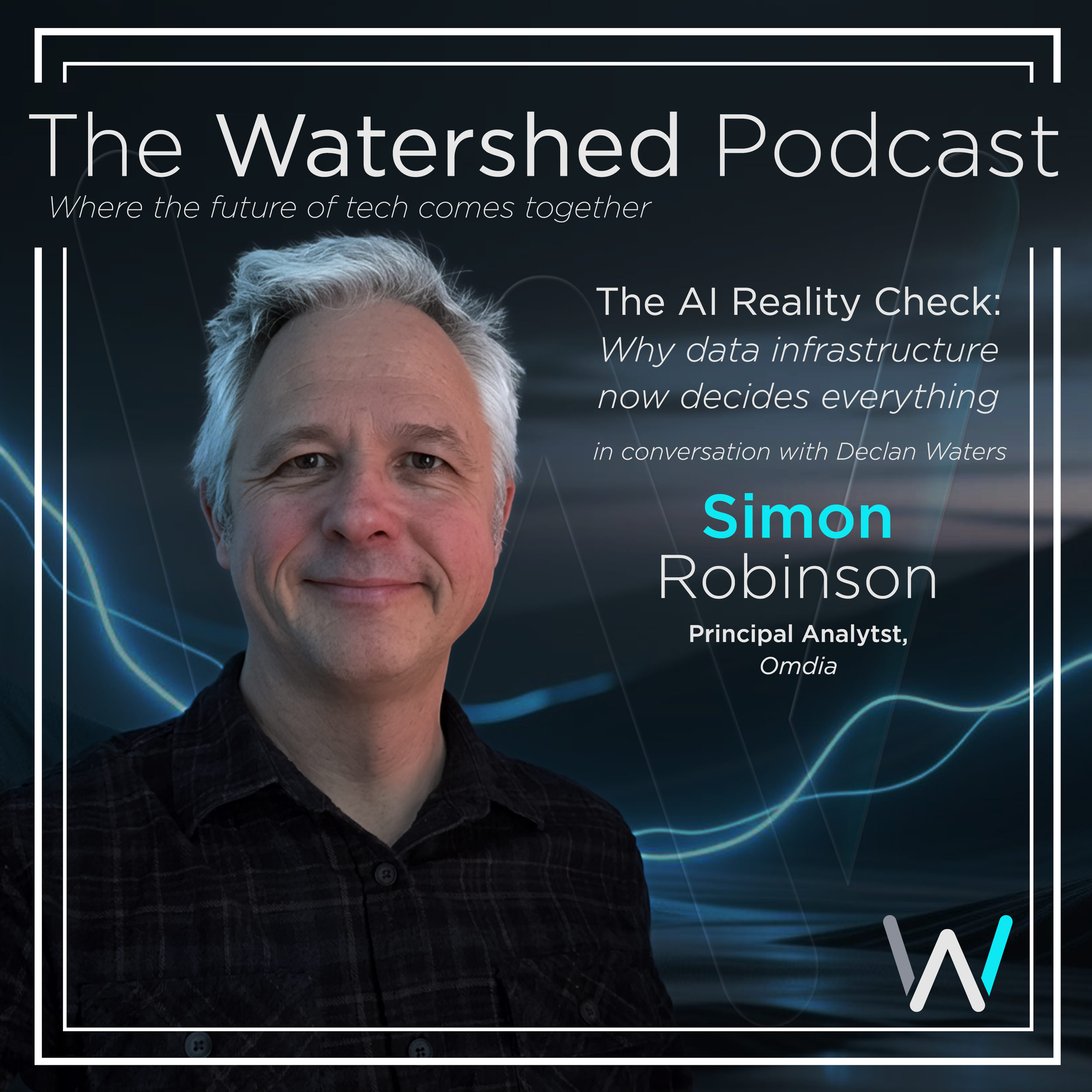
The AI Reality Check: Why Data Infrastructure Now Decides Everything
Key Takeaways
AI infrastructure conversations have shifted from compute to data, with storage now a critical bottleneck.
Inference at scale is driving unprecedented demand for real-time data access and high-performance storage.
Many organizations are not fully prepared, with legacy data architectures limiting their ability to scale AI initiatives.
Successful AI deployment depends as much on people and processes as it does on technology.
Fear of missing out is balanced by fear of getting it wrong, slowing enterprise adoption.
Proof of concepts are a necessary part of learning, even when they fail.
AI success requires a clear data strategy, not just investment in tools or models.
Infrastructure teams are regaining strategic importance as AI moves into production environments.
Simon’s Watershed Moment
Simon’s watershed moment was not a single event, but a realization shaped over time through his career as an analyst. As the industry evolved, he recognized the limitations of working within silos and the value of broader collaboration.
Moving from smaller firms into larger research organizations exposed him to a wider network of expertise, where combining insights across teams significantly enhanced both his perspective and the value delivered to clients.
This shift in mindset, from individual expertise to collective intelligence, reshaped how he approaches his work. In today’s AI-driven landscape, that lesson has become even more relevant, reinforcing the idea that no single domain can solve complex challenges alone.
Full Transcript:
Declan Waters (00:06.212)
Welcome to The Watershed. This is The Watershed podcast where we talk about moments and things that change for good. There’s no going back. In leadership, technology and business, we’re living through one of those moments right now.
On this podcast, I sit down with leaders who have hit that inflection point in their careers or are shaping what comes next. We talk honestly about what changed and why it mattered.
Hi everyone, I’m Declan Waters and welcome to The Watershed. Today I’m joined by Simon Robinson, a seasoned principal analyst at Omdia. He is a technology industry analyst and research leader with more than 25 years of experience, delivering value as an individual contributor and building and leading technology research organizations.
He is a recognized authority on key emerging enterprise technology topics spanning the breadth of technology and digital transformation, with deep experience in critical data center infrastructure. So we’re talking about cloud, compute, storage and data.
Over the years, he’s built deep and impactful relationships as a trusted advisor to the C-suite and many Fortune 500 technology companies, service providers and startups. But more importantly, he’s been a friend of mine for over 20 years.
Simon, great to have you on the podcast.
Simon Robinson (01:30.754)
Thanks, Declan. That was quite the introduction.
Declan Waters (01:33.764)
There we go. Where do we go from there?
We’ve both been in the industry a long time, Simon. We’ve seen a lot of different areas of transformation. But right now everyone’s talking about AI. Boards, vendors, the press. It can be hard to know exactly what’s real and what’s noise.
So why don’t we start there. From your vantage point, what do you think is happening right now and what should we be paying attention to?
Simon Robinson (02:11.498)
Yeah, very interesting question to kick off. It seems like an entirely different world and industry from the one we were in just a few years ago. The pace of innovation across the stack is mind blowing. It’s almost a full-time job just keeping up with everything.
From my vantage point at Omdia, my focus is on understanding what needs to happen at an infrastructure level, particularly within data and storage, to make AI successful.
That sounds like a high-level statement, but what that actually requires is hugely variable and constantly evolving.
What makes this moment so interesting is that data infrastructure, and by association storage, is now at the center of the conversation.
If we rewind two years, AI infrastructure discussions were all about compute. GPUs, access to GPUs, cost, deployment. But it turns out GPUs are just one part of the equation.
Storage wasn’t really part of the conversation back then. Even we wondered when it would become relevant and what that would look like. I don’t think anyone anticipated how significant it would become.
Around mid-last year, there was almost a big bang moment for storage. As we moved from training to inference, where real value is realized, the demand for data exploded.
Hyperscalers and cloud providers realized almost overnight that they needed far more capacity than expected. We’ve since seen an unprecedented spike in demand for memory and fast storage, especially flash.
As inference scales, context windows grow, prompts become more sophisticated, and we move into an agentic world, the demand for real-time data changes everything.
Even Nvidia is now deeply invested in storage, because the system is only as strong as its weakest link. Storage and data infrastructure need to be fixed.
So what we’re seeing is a massive wave of innovation. Storage has gone from being part of the conversation to being critical.
Declan Waters (07:26.392)
That’s a great framework. Are you essentially saying the GPU wars are now won and the real fight is around data?
Simon Robinson (07:41.822)
Yes, in simple terms. There’s no AI strategy without a data strategy. Garbage in equals garbage out.
As we move into deploying AI at scale, particularly inference, things become more tangible. This is where AI starts delivering real business value.
That’s when organizations start to care deeply.
Declan Waters (08:39.512)
You mentioned recently that 70 percent of IT leaders say storage is a barrier to AI success. Did that surprise you?
Simon Robinson (08:57.509)
It was higher than I expected. Even organizations in early stages can already see the pressure on their storage environments.
They need more performance, real-time responsiveness, better data ingestion, and strong governance and compliance.
There’s a tension between fear of missing out and fear of getting it wrong.
It ultimately comes down to how well organizations understand their data. Many still have siloed environments and limited governance across the business.
Storage is part of the problem, but it connects to a broader challenge across data pipelines, infrastructure, and workflows.
Declan Waters (11:34.415)
So companies want to move fast, but broken data foundations hold them back?
Simon Robinson (12:02.351)
Exactly. Architecture matters. Data and storage architecture need to evolve. If the foundations are flawed, scaling becomes difficult, risk increases, and costs rise.
Declan Waters (12:45.274)
Do infrastructure teams now get a seat at the table again?
Simon Robinson (13:03.238)
Yes, but it’s part of a broader effort. It takes a village.
Infrastructure is critical, but it needs to work closely with data engineers and the rest of the organization.
This isn’t just a technology problem. It’s people and process as well.
Declan Waters (14:32.41)
How prepared are organizations really?
Simon Robinson (15:29.861)
Some are fully ready, but most are not. It’s a typical bell curve. Many are experimenting but not fully committed.
There are real concerns around jobs, security, and risk. However, the last six months have shown a shift, especially with agentic AI driving real use cases.
Many organizations fell into the trap of running proofs of concept without clear outcomes.
Declan Waters (16:37.124)
How do you separate real innovation from hype?
Simon Robinson (17:04.133)
You look at multiple signals.
Organisations face challenges around cost, data quality, and scale. The issue isn’t the technology itself, but integrating it into existing environments.
POCs failing is part of the process. That’s how learning happens.
But we are seeing real benefits emerge. Once organisations see value, adoption accelerates.
Declan Waters (18:59.674)
Who owns this problem?
Simon Robinson (19:19.62)
It depends, but largely it’s driven top-down by the C-suite.
Organisations are creating AI centres of excellence to explore use cases.
They start with low-risk, high-value applications to build confidence and expand from there.
Declan Waters (21:13.86)
What excites you most in storage right now?
Simon Robinson (21:48.929)
There’s innovation across the entire stack.
AI at scale is fundamentally an IO problem. Getting data into chips quickly is critical.
Storage companies are deeply focused on solving this.
We’re seeing innovation in areas like KV caching for inference, integration between data and storage layers, and smarter data-aware systems.
There’s also massive innovation in hardware, flash, and hard drives.
And beyond AI, there’s work around ransomware protection and cloud-native storage.
It’s an incredibly exciting time.
Declan Waters (25:49.355)
Let’s talk about your watershed moment.
Simon Robinson (26:22.463)
That’s a tough one. There have been many.
One key realization was the importance of collaboration.
Moving from smaller firms to larger organisations showed me the value of combining expertise across teams.
Breaking out of silos and working across domains significantly improves outcomes.
Internal collaboration can be just as valuable as external relationships.
That shift changed how I approach my work and how I deliver value.
Declan Waters (30:19.29)
That’s a great way to end. Simon, thank you.
Simon Robinson (30:47.397)
Thanks, Declan. Really enjoyed it.
Declan Waters (31:27.31)
Thank you very much. Take care.