
Episode 11
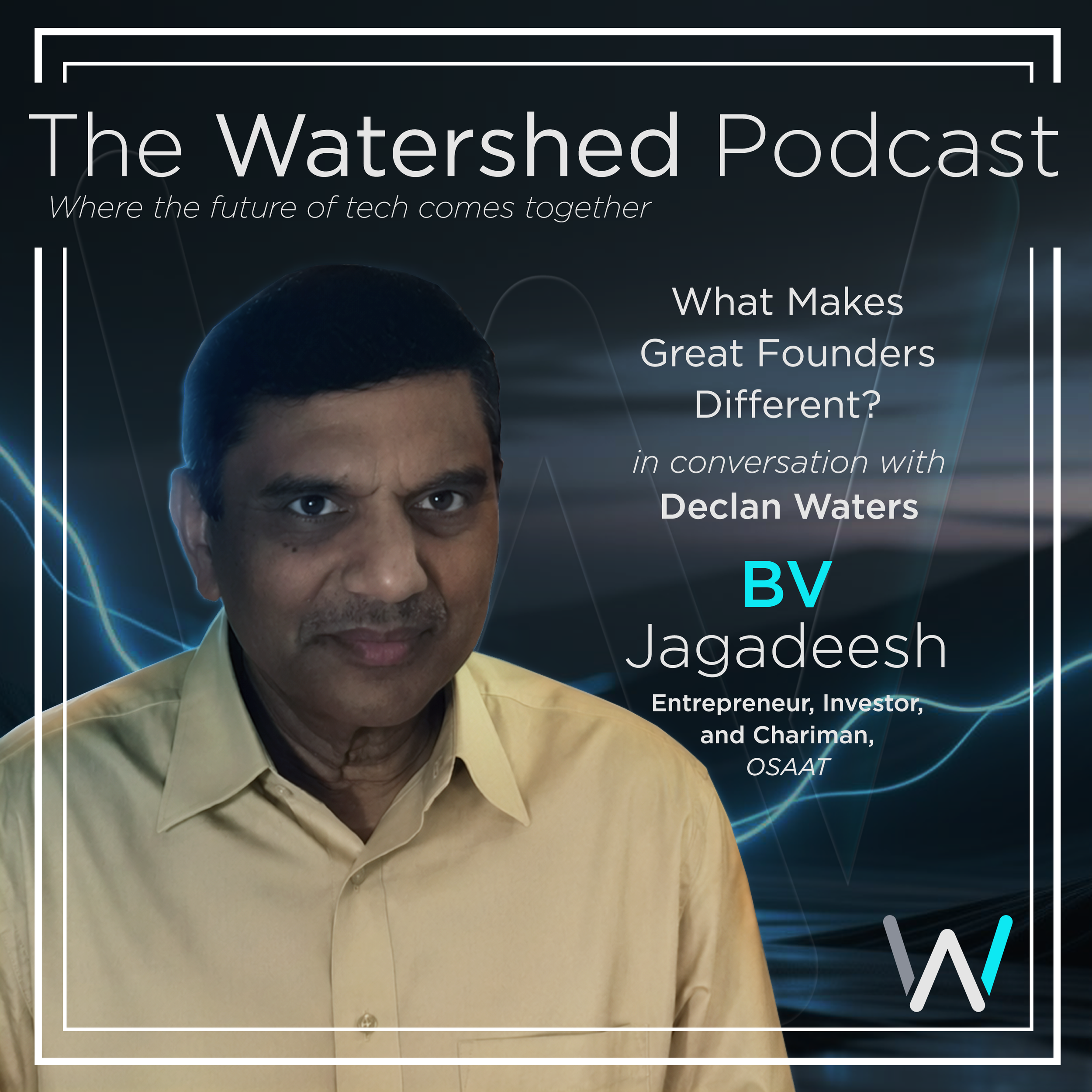
What Makes Great Founders Different?
Key Takeaways
Great founders combine domain expertise, courage, and a willingness to take calculated risks.
Building strong networks and relationships can create opportunities that would otherwise never exist.
Successful entrepreneurs must be willing to pivot when markets change.
The dot-com crash demonstrated the importance of sustainable business models over hype.
AI presents significant opportunities, but not every company will succeed.
Many of the most transformative AI applications have yet to be imagined.
Trust is the foundation of both successful businesses and successful nonprofit organizations.
Transparency and integrity are essential leadership traits for founders.
Supporting the next generation of entrepreneurs can create a lasting impact beyond financial success.
BV’s Watershed Moment
B.V.'s defining watershed moment came when he decided to leave the security of employment and start Exodus Communications in 1993.
At the time, venture capitalists were often skeptical of immigrant founders and funding was difficult to secure. Rather than relying on outside investment, B.V. carefully planned for the possibility of failure, saving enough money to support himself and his family while giving the business a chance to succeed.
He created six-month and one-year milestones to evaluate progress and determine whether to continue pursuing the venture or return to traditional employment.
As customer orders began to arrive and angel investors such as Kanwal Rekhi offered support, B.V. gained the confidence to continue building the company.
That decision ultimately led to the creation of one of the internet's most important infrastructure companies, with Exodus Communications eventually hosting between 40% and 50% of the world's internet content.
For B.V., taking that calculated risk changed the course of his life and laid the foundation for everything that followed.
Full Transcript:
Declan Waters (00:01.663)
Hello everybody. I'm Declan Waters, and welcome to The Watershed Podcast.
Today I have a very special guest with me, B.V. Jagadeesh, one of Silicon Valley's most prolific operators and investors.
He's helped build the infrastructure underneath the early internet at Exodus Communications. He founded NetScaler, was an early investor in Nutanix, and today through Kaaj Ventures, Silicon Valley Quad, and other vehicles like VentureDock, he's also the bridge between the Valley and the next generation of Indian founders.
And if that's not enough, he's also the Chairman of OSAAT (One School At A Time), a nonprofit that has rebuilt over 100 rural schools across India, impacting tens of thousands of children every single day.
B.V., it's a real pleasure to have you on The Watershed.
B.V. Jagadeesh (01:02.136)
Such a pleasure, Declan, to be on this podcast and also to meet you after a long time.
Declan Waters (01:07.753)
Thank you, sir.
Well, we've got lots to talk about, but not enough time, unfortunately. So I'm going to get straight into it and go back to the early days of B.V.'s personal journey and business journey.
So maybe take me back and take me back down memory lane to where it all started for you, B.V.
B.V. Jagadeesh (01:28.768)
Yeah, so it's kind of a very interesting, turbulent journey, especially in the early days of my life, mainly because I come from a small village in India, which is about 40 miles outside of today's Silicon Valley of India, which is Bengaluru.
And 40 miles doesn't seem like a lot of distance, especially in the U.S. But in India, 40 miles back in the 1960s was a long journey.
So I studied in the rural village, and you mentioned OSAAT. One of the reasons why we are helping to rebuild these government schools is because I was one of the recipients of going to a government school until the seventh grade in my village.
And there was no high school in the village.
I had to move to the city to get my high school and then my college education.
I was very fortunate to have parents who emphasized education a lot.
And somehow we managed to stay in the city along with my brother. My parents continued to live in the village. They could not move out.
So we had a small room for ourselves, we cooked our own meals, and both of us went to school. I went to high school, and that was the journey for us for almost seven or eight years until I got my engineering degree in India.
Then I got admission into a master's degree program in Bombay, which today is called Mumbai. And I think that was the major turning point of my life. Because while doing my master's degree, I somehow managed to get an internship with a startup company.
Interestingly enough, this was way back in 1979. During the summer of 1979, when I got that internship, I was introduced to working on microprocessors in India. And I can bet you that even in the U.S., it was a novelty at that point in time.
I got to work on the Motorola 6800 microprocessor, and I did lots of projects using these microprocessors. I think that gave me a phenomenal advantage over many others. And that also helped me get my first job, again in another startup company in Bombay itself, which was an Intel representative in India.
So they were selling Intel products, and I got to work on them. Intel used to build systems called Microprocessor Development Systems. If any of your listeners are from the 1960s and 1970s, they would know Intel used to build these development systems because PCs were not yet prevalent in the market at that time.
These Intel Development Systems were being used by researchers to develop single-board computers and microprocessor-based embedded systems.
So I got an opportunity to work on that and support it for our customers. And that's what helped me get my first job in the U.S. back in 1982. So I came here with a job already in hand through a company called Alexi Computer Corporation.
Declan Waters (05:21.205)
Okay, so then you make the leap to Silicon Valley, and that's something we have in common. I came to Silicon Valley from the UK, as you know.
So you made the jump. What was the gap, B.V., between the expectation and the reality when you came to Silicon Valley?
What was that like for you?
B.V. Jagadeesh (05:42.201)
Well, I think the expectation was that it was going to be a difficult journey, a difficult ride, especially getting adjusted to a totally new life.
You're 10,000 miles away. People are different. The culture is different.
And even the language was different in some ways because I had always lived in India. I had a very thick accent, and I had to get adjusted to speaking in a way that everyone could understand.
Of course, over the years I adapted myself, so now not very many people ask me to repeat what I say. But in those days, a lot of people used to ask me to repeat the same thing multiple times because it was hard for them to understand.
So these were some of the challenges that I thought were going to be major roadblocks to accomplishing whatever goals brought me here.
But it turned out differently. Number one, the people I worked with were absolutely fantastic. They were so friendly and welcoming toward someone like me who had come from a different country.
I didn't even have a formal education in the U.S. So having to interface with people, and given that there were very few Indians who had migrated from India to the U.S. at that time, it was all local people.
And it was an absolutely fascinating experience for me.
I made some phenomenal friends, both professionally and personally. People taught me swimming. People taught me skiing. People taught me tennis. So it was a beautiful experience to be here.
Believe it or not, within just a week I was pretty much up and running with my own apartment, my own life, and my own cooking. It was a very different reality from what I had expected when I arrived in the U.S.
Declan Waters (08:12.584)
Yeah, I can even sense when you're talking about this, B.V., that it brings back very fond memories for you.
Starting out in America, the excitement of it all, the thrill of it, the "who knows what's going to happen" mentality, right?
What did you find out about the people? Because I think you had the founding instinct inside you.
What, in your opinion, is the difference between people who start something and people who join something?
What do you think is the fundamental difference between those two kinds of personas, B.V.?
B.V. Jagadeesh (08:49.646)
People who start something new versus people who join something?
Yeah. In fact, during the first 10 or 11 years of my journey here, I was always fascinated because I came here with the intention that someday I was going to start my own company.
And I thought this would be the best place for an entrepreneur to thrive and succeed, given the opportunities that existed here and the market that existed here.
I kept observing every startup company that I worked for between 1982 and 1993 or 1994. And luckily, one of the things I did was enroll as a volunteer with IEEE in the Silicon Valley chapter almost from day one.
As soon as I arrived, I wrote a letter to IEEE headquarters and they put me in touch with the Silicon Valley chapter. They were very excited because I was offering to volunteer for the organization on my own initiative.
It's actually hard for organizations to find people who are self-motivated enough to volunteer. Honestly, that gave me a phenomenal opportunity to work with some wonderful people who were part of IEEE.
We were building all these conferences. Because of that, I got exposure to many entrepreneurs and CEOs. I was responsible for reaching out to them, inviting them to speak at the conferences we were organizing.
So I was keenly observing at that time. Why could this country produce so many entrepreneurs who could start companies, and why couldn't we do the same thing back home?
That was the question. Back in India, most entrepreneurs were running very small businesses, often family-run businesses. The large companies were conglomerates, typically built and grown by families, such as the Tatas, the Birlas, and others.
These were all large family-owned enterprises. What I noticed here was the ability of people to come up with an idea to solve a problem that existed in the market.
They gained that insight because of the deep experience and domain knowledge they had built over the years.
Second, they had the courage to leave their jobs and start something new.
Third, even back then, there were venture capitalists and investors willing to bet on those entrepreneurs.
The combination of those three things resulted in these wonderful entrepreneurs taking the risk of leaving comfortable jobs at companies like Hewlett-Packard, Intel, and others to build new businesses.
And then they attracted people they had worked with previously to join them.
The entire equation of how these things happened was absolutely fascinating.
When I started my own company in 1993, Exodus Communications, I followed exactly the same model.
I had domain expertise. I had domain knowledge. I had a network of people I knew from the past. And because of my IEEE connections, I was exposed to many potential customers.
When we started reaching out to those people, they were very open to having conversations with me.
I don't know if I could have done the same thing back home in India.
Declan Waters (13:17.045)
So when you look back at the whole arc, B.V., from VJTI, the move to the Valley, Exodus, NetScaler, Nutanix, what's your view on the watershed moment?
The decision, the risk that you took where you felt there was no going back.
The moment you decided to change direction for the better. The calculated risk where you decided to go for it. Can you think of moments in your career that stand out?
B.V. Jagadeesh (13:45.517)
Yes.
One thing that was different, especially for an immigrant entrepreneur in the 1990s compared to today, is that venture capitalists were very skeptical about immigrant entrepreneurs.
They always viewed immigrants as technologists. They never really considered us as people who could one day become entrepreneurs or CEOs.
We were put into the bucket of being technical people. Even if we started a company, the assumption was that we would eventually be replaced by a professional CEO.
That was the mindset of many investors until around 1999 or 2000. So we started with that assumption, which was fine. Maybe at some point an outside CEO would come in.
But because venture capitalists were not willing to invest in our company initially, I planned my life in a very deliberate way.
For the first two years, I wanted to make sure I could survive on my own.
Declan Waters (15:10.089)
Oh yeah, very smart.
B.V. Jagadeesh (15:11.656)
And thanks to my wonderful family, who gave phenomenal support, we were able to live off our savings rather than income.
My thought process was simple. I'm going to try this. I'll create milestones every six months. At each milestone, I'll evaluate whether I have a realistic chance of moving forward or whether I should simply go back to my normal life.
After six months, we landed some large orders. That gave me confidence. But I still wasn't convinced that I could build a successful company. My next milestone was one year.
Originally, I told myself that I would give it one year. If I wasn't succeeding, then there would be no shame in returning to a regular job. My family came from an educational background.
Nobody had run a business. Nobody really understood finance, risk-taking, or entrepreneurship. So I gave myself one full year to determine whether I could succeed as an entrepreneur.
If I succeeded, great. If not, there would be no real damage because I had saved enough money to support myself for another year while looking for a job.
That was my assumption. Fortunately, while venture capitalists didn't support us during the first year and a half, we were able to build a customer base and generate revenue.
We then received support from some wonderful angel investors such as Kanwal Rekhi and others who are legends in Silicon Valley. They helped us secure funding.
And after we got funding, there was really no looking back. We simply continued building toward our dream. At one point, Exodus Communications was hosting somewhere between 40% and 50% of the world's internet content in our data centers.
Declan Waters (17:44.918)
Wow. That's quite something, isn't it? That's a hell of a statistic. That's incredible.
It certainly went well and went from strength to strength. At what point did you start thinking about moving into the investor role and the board-member stage of your career?
B.V. Jagadeesh (18:03.982)
Yeah. After Exodus, I started NetScaler. And because of the dot-com crash in 2001, we went through some rough times. But we managed to come through it.
We managed to pivot. In fact, these are some of the things I teach in my entrepreneurship classes. And every time I speak to entrepreneurs, these are some of the stories I share.
Be prepared to pivot if your product isn't working. Or if the market sees your product as a nice-to-have rather than a must-have. Learn from customers. Don't become emotionally attached to your original idea and keep wasting time.
That's exactly what we did. Because of the dot-com crash, the original problem we were solving became more of a nice-to-have feature. So we went back to the drawing board.
We pivoted the company based on the same underlying technology. We rebuilt the product. Because of that, we had to make some very difficult decisions. We reduced the company from nearly 100 people down to 50.
That was a very tough experience. But once we pivoted and launched the new product, it took off.
B.V. Jagadeesh (20:02.982)
Once we pivoted and launched the new product, it took off. We had a great exit in 2005, and I stayed with Citrix for several more years.
By 2010, I decided that I had gained enough experience building companies and learned enough lessons along the way.
I felt it was time to give back and help create more entrepreneurs and guide them.
In fact, the challenge I gave myself was this:
I believed I could help more entrepreneurs succeed than the traditional venture capital model would suggest.
Classically, if a venture capitalist invests in 20 companies, they expect perhaps two of them to become blockbuster successes.
Another five to seven may become acquisitions.
And the remaining companies typically return somewhere between zero and fifty cents on the dollar.
If that happens, the venture capitalist can return roughly four to five times the capital that their limited partners invested.
I felt that by bringing operational experience to founders, I could improve those odds.
Out of 20 companies, perhaps I could help 15 become successful.
I'm not there yet, but if you look at my portfolio and compare the successes and failures, I think the ratio is somewhat better than the traditional Silicon Valley average.
Declan Waters (21:27.335)
I think that is absolutely fair to say, B.V. Looking at your track record, there's absolutely no doubt about that. Nutanix is something I want to touch on briefly.
That's fortunately how we met. Talking about picking winners, you backed Dheeraj very early. What did you see in him and what did you see in the idea before the market did?
B.V. Jagadeesh (21:52.025)
What I liked about Dheeraj was that he reached out to me through Lightspeed.
And he said, "I need a mentor who has been there and done that." I think that's one of the greatest qualities of an entrepreneur.
Recognizing that you know some things, but also recognizing how much you don't know.
And being willing to learn from someone who has gone through the journey before you so that you don't make the same mistakes.
The fact that he made the decision to reach out to someone who had been there and done that immediately told me that this was an entrepreneur I wanted to work with.
I received an email from the venture capitalist who said:
"Dheeraj has started this company with two other founders. He wants a mentor who has been there and done that. He'd like to talk to you to see if you can help."
It so happened that the company I was running at the time was located in the same building as their office, which I didn't know beforehand.
And it also happened that the suite they occupied was the exact same suite we had used at Exodus Communications.
Once he learned that, he became thrilled. He said, "Wow, there must be good energy in this suite because a successful company was already built here."
Declan Waters (23:42.262)
Yes, yes. That's great.
Great lessons from Dheeraj there in terms of humility and being willing to ask for help from people who have already done it.
One of the traits that marks him out as a great founder.
B.V. Jagadeesh (23:59.151)
The way he explained the problem and the solution they were building absolutely fascinated me. This was directly within my core competency, which is infrastructure.
Having built Exodus and having worked extensively with storage technologies from Sun Microsystems, Veritas, and others, I understood there was a significant opportunity for a hyperconverged platform from a scalability perspective.
It was fascinating to work with Dheeraj, Mohit, Ajay, and the other co-founders. And it was also incredibly rewarding to be part of the Nutanix IPO journey.
It brought back many memories for me because we had taken our own company public back in 1998.
Declan Waters (24:59.061)
You did. One of the things I love about having seasoned entrepreneurs like yourself on the podcast is that you have so much perspective on the history of this industry.
Take me back to the dot-com bust. You witnessed firsthand the difference between companies that had real businesses and companies that simply had narratives.
What are you seeing in AI today that reminds you of 1999? And what feels different this time around?
B.V. Jagadeesh (25:33.529)
Back then, I think investors became overly excited about the internet and started assuming that every company would instantly become a global market leader.
That assumption was far-fetched. Take companies like Webvan or Pets.com.
Nobody really worried about the business model itself.
Declan Waters (26:10.899)
Yes.
B.V. Jagadeesh (26:23.458)
For example, Pets.com was delivering pet food. Pet food is heavy.
The transportation costs alone were enormous relative to the value of the product being sold. There was no realistic path to profitability under those economics, unless you became part of a much larger ecosystem like Amazon eventually did.
I think investors made a fundamental assumption that every internet company would become a dominant global player. Conceptually, they weren't completely wrong because we eventually saw some companies achieve that.
But making those assumptions without understanding whether the business model actually worked was flawed. That's what ultimately led to the dot-com crash.
One company after another discovered they couldn't raise more money. They weren't making money. The whole "eyeballs" concept began to disappear. And once companies started failing, it became a flood.
Many of those companies happened to be Exodus customers as well, and they ended up shutting down.
So that was a difficult period. I think the difference between then and now is that there is definitely a tremendous amount of hype in the market today.
Recently, we've spoken with companies that have little more than a PowerPoint presentation, albeit with brilliant founders and compelling AI ideas.
Yet someone has already offered them a term sheet at a $55 million valuation. Personally, I would never do that. But that's the level of excitement investors are showing toward AI founders today.
The real question is whether those companies can turn ideas into revenue quickly.
B.V. Jagadeesh (28:46.242)
The real question is whether those companies can turn ideas into revenue quickly.
I think that's the reason venture capitalists are betting on great entrepreneurs who can take an idea, build with a very small team, and generate meaningful revenue.
If they can do that, it's a fantastic achievement. But like anything else, not every company is going to succeed. Some will succeed, and many will fail. And if enough of them fail, it could create significant challenges for investors.
That's when you'll start to see a correction in the market. But in general, I'm an optimist. I'm a believer that once the entire AI stack is fully built out, there will be tremendous opportunities.
Today, everybody talks about the five-layer AI stack. There are already plenty of opportunities across those layers. And once entrepreneurs solve those foundational problems, I think the applications that emerge will be things we can't even imagine today.
I always like to use the analogy of the internet. When we were building the internet backbone in the mid-1990s, we were deeply involved in creating that infrastructure.
If somebody had told me back then that one day we would watch nearly all our movies online, I don't think I would have believed it.
Declan Waters (31:05.737)
Yeah. Yeah.
B.V. Jagadeesh (31:13.258)
If someone had told me that one day you could rent a stranger's house near a beach through an application like Airbnb, I would never have imagined it.
Nobody imagined Uber. Nobody imagined Netflix becoming what it is today.
And very few people imagined Amazon reaching a point where many young people rarely go shopping in physical stores anymore because they buy everything online.
You simply couldn't have imagined those things when we were building internet infrastructure in the 1990s.
I feel the same way about AI. There are applications today that everyone can understand. Call centers. Code generation. Productivity tools.
But there are also many applications that haven't even been imagined yet.
Once this five-layer stack is built properly, reliably, securely, and with minimal hallucination, I think we'll see entirely new categories of companies emerge.
And those unknown applications are what I believe will create hundreds of millions of jobs and enormous amounts of wealth around the world.
Declan Waters (32:27.721)
Yeah. That's really insightful. Thank you, B.V., for your thoughts on that.
I've got two more questions for you. One is about another big problem you're trying to solve, and that's OSAAT, which you've described as another startup, just in the nonprofit world.
What did you learn about building companies over the last 30 years that has helped you scale OSAAT? And what's been different about this experience for you?
B.V. Jagadeesh (33:01.902)
That's actually a beautiful question.
In the nonprofit world, the biggest difference between a traditional business and a nonprofit organization is that nonprofits are largely run by volunteers.
That means people have to be inspired to give their time to the cause. In the business world, it's much more straightforward. People join a company knowing that if the company succeeds, there is a financial return that can improve their lives and the lives of their families.
When we built Exodus, we created many millionaires. People would come to my office and tell me:
"Thank you for starting this company. Because of this company, I was able to buy a house. Because of this company, I was able to send my children to great schools."
In the nonprofit world, there is no financial reward. The only reward is knowing that your time and effort are helping someone else. Maybe it's a student. Maybe it's someone who is homeless. Maybe it's someone whose life is improved because of the work you're doing.
That's the biggest difference.
The second thing I learned, and one of the reasons I always say that I spend 60% of my time on capitalistic opportunities and 40% on social-impact opportunities, is that both worlds actually support each other.
As I help entrepreneurs become successful, I can encourage those entrepreneurs to support nonprofit causes. One of the biggest challenges nonprofit organizations face is trust. People who have created wealth often hesitate to donate because they don't trust that their money will be used wisely.
Declan Waters (35:46.111)
Yes.
B.V. Jagadeesh (35:55.247)
If you look at many nonprofit organizations, a significant portion of donations can be consumed by overhead costs, salaries, travel expenses, and administration.
People who worked hard to create their wealth naturally ask why they should donate if most of the money isn't going directly to the cause.
In our case, people know me. They've worked with me. They trust me. I can act as a bridge.
I can give them confidence that if they support OSAAT, 100% of their donation is going directly toward the cause.
When I say that, there is trust behind those words. It's fascinating to see how success in the entrepreneurial world creates opportunities to support meaningful social causes.
Declan Waters (37:23.305)
Yeah. You mentioned a bridge, and that's actually a lovely segue into my last question.
Think about the first-time founder who is arriving in Silicon Valley today. Maybe they're coming from India. Maybe they're coming from somewhere else in the world. They're looking for something bigger.
They want to build something meaningful. They want to follow a path similar to yours. They're entering a world they don't fully understand yet.
Beyond technology and beyond deals, what's the one thing they should be thinking about?
What's the one piece of advice you would give them?
B.V. Jagadeesh (38:02.412)
Yeah.
We created this incubator, VentureDock, which encourages entrepreneurs from different parts of the world to come and learn from our experiences.
Hopefully that helps them make fewer mistakes, or at least make new mistakes rather than repeating the ones we already made.
So the one thing I would say is this:
Be as honest and transparent as possible.
Because if you try to cut corners in anything you do, it will eventually come back to haunt you.
Whether it's financial matters, how you treat employees, or any other aspect of building a company, it always catches up with you.
If transparency is not built into your relationship with employees, you may get their time, but you won't get their hearts and minds.
You want people who work for you, or work alongside you, to give more than 100% of themselves.
And I think the only way to achieve that is by creating an environment built on trust.
As a leader, it's your responsibility to create that atmosphere within the organization.
And if you do that, I think a lot of great companies can be built.
Declan Waters (39:46.643)
Yeah.
Well, that's some great advice for any founder looking to come to the U.S., or anywhere in the world for that matter, from someone who has truly been there and done it.
You've seen everything over the years. And I'd just like to say a big thank you, B.V., for coming on The Watershed Podcast.
I've really enjoyed this conversation. It's been wide-ranging, especially considering the short amount of time we've had together. Keep doing what you're doing.
You're doing very important work through the companies you're investing in, but also through OSAAT.
The rumor is that your tennis game is getting better and better. Keep going. Keep going.
And I hope to see you in the Valley, or somewhere else in the world, very soon.
B.V. Jagadeesh (40:27.202)
When you're here next time, let's play some tennis.
Declan Waters (40:30.217)
Let's do it. I'll happily do it. Just take it easy on me. Thank you, B.V.
B.V. Jagadeesh (40:32.436)
All right. Take care. Thank you.