
Episode 14
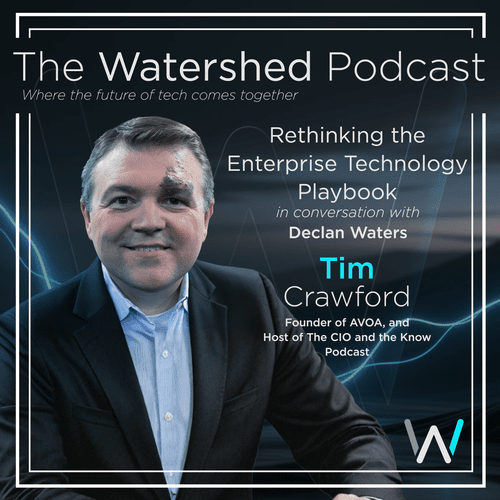
Rethinking the Enterprise Technology Playbook
Key Takeaways
Enterprise AI adoption is moving from the initial FOMO phase toward a more measured focus on practical value and risk.
CIOs need to understand where organizations can move quickly with AI and where greater caution is required.
Customer experience, employee experience and business operations are three interconnected areas where AI can create meaningful change.
Agentic AI presents significant opportunities, particularly for multi-agent and multi-step workflows, but also raises new questions around identity, governance and guardrails.
Quantum computing is fundamentally different from classical computing and should not simply be viewed as a faster version of existing technology.
The way humans interact with technology will become increasingly important as AI and other emerging technologies evolve.
The scale of investment in AI infrastructure could become a challenge if enterprise adoption and revenue do not accelerate alongside it.
Successful AI adoption requires an intimate understanding of the business problem being solved, rather than starting with the technology itself.
Curiosity and conviction can become powerful career advantages, particularly when an idea or approach has not yet become mainstream.
Tim’s Watershed Moment
Tim's watershed moment was less about a single event and more about an idea he held onto from the beginning of his career: that business and technology needed to be much more closely connected.
When Tim began working in IT in the late 1980s and early 1990s, he felt like something of an outlier because he was interested in more than using technology to solve individual business problems. He wanted to understand how technology could be used strategically to advance and differentiate the business.
At the time, that way of thinking was not necessarily valued in the same way it is today. Rather than abandoning it, Tim stuck with his conviction and continued developing his understanding of both sides of the equation, eventually earning an undergraduate degree in computer science and an MBA in international business.
Today, that intersection between business and technology sits at the heart of many of the conversations surrounding AI. As Tim explains, organizations cannot use AI effectively without first understanding the business problem they are trying to solve.
For Tim, the lesson from his own journey is to remain curious and stick with the ideas you genuinely believe in. Prove them out, prove yourself wrong if necessary, and if they do prove out, double down.
Full Transcript:
Declan Waters (00:01.318)
Hello everybody. My name is Declan Waters and welcome to the Watershed podcast.
Today my guest is Tim Crawford. Tim has spent nearly three decades driving operational excellence at companies like Stanford University and Phillips Electronics before stepping away and starting AVOA and becoming one of the most quoted independent voices advising global 2000 boards on AI, cloud and digital strategy. He facilitates an elite community of transformational CIOs and also hosts his own show, The CIO and the Know, and most recently runs the CIO Think Tank. Tim, welcome to the Watershed.
Tim Crawford (00:46.218)
Hey, great to be here. Thank you for the invite. I'm honored to take part.
Declan Waters (00:51.026)
Thank you very much. And it's great to see you. We do see each other, don't we, at various conferences throughout the years. Always a delight bumping into you and grabbing some of your time, but when I can, you've always been incredibly generous and met some of the Waters Agency clients over the years, and they've always appreciated your opinion and insights on the industry. I've got to say, just to start off, where are you in the world, Tim? Because I never quite know where you are.
Tim Crawford (01:18.284)
Yeah. I get that a lot because, for anyone that does follow me, they tend to see that I bounce around a lot literally all over the globe. Today I'm actually in my home office in Los Angeles, California. So glad to be home and enjoying a little bit of being home for a bit before we're back at it again and back onto an airplane.
Declan Waters (01:45.316)
Back on it absolutely. Well, we really appreciate you spending the time with us today, Tim. And I think just for the level set and for anyone in our audience who's been living under a rock and doesn't know you, I thought it might be good just to start off with maybe just framing this conversation with, and I alluded to a bit of it in my introduction there, but just that professional arc of where Tim Crawford started and where we are today. It'd be just great to set the scene to him for us if that's okay.
Tim Crawford (02:16.459)
Yeah, and you know, it's always an honor to hear how people characterize my past and history and their viewpoint of who I've become and it's a little bit of that, who is that person? I'd really like to meet them someday. You know, I started my career in IT. I got the bug, got the IT bug, and really enjoyed it working in large enterprise. now as a little bit of an
Tim Crawford (02:46.705)
...of an outlier in the sense that I didn't stay with one industry. I kind of bounced around from different industries, which actually led to one of my superpowers being able to take things from one company in one industry and apply it to another industry altogether. However, when I started my career, that was not necessarily a good thing. Today, that's a great thing. And I think this just kind of shows you that over time, what people need and how companies operate change. How we lead, how we work, how we engage with other folks, all of that is changing and up for grabs. And so you have to be flexible. You have to be curious about how you're working.
And so one of the things, for example, that I would ask about is, so help me understand, we're doing this technology change. What does that mean to our business? And I can remember one CIO I worked for many, many, many, many moons ago telling me, Crawford, just be quiet and do the work, and it doesn't matter for you. Today, that's a whole different story. And so it's been a great ride. I've had a lot of amazing..
Declan Waters (03:58.547)
Mm-hmm.
Tim Crawford (04:05.325)
..amazing opportunities. You mentioned, you know, being able to work at Stanford at the Graduate School of Business, working with some amazing people, just some amazing leaders and just the energy that that institution exudes. It's just amazing. And then Phillips Electronics, Knight Ridder, all covered, Konica Minolta, National Semiconductor. It's been a great ride. But…
Declan Waters (04:34.386)
Okay.
Tim Crawford (04:34.505)
..as I was looking for my next opportunity, my next leadership role, kind of fell into understanding how the industry is evolving, how technology is evolving, kind of taking those tools that I had honed over the course of my career and saying, how do I apply that to a broader audience? And that's really where I kind of transitioned into an advisory role working with other CIOs.
And then eventually working with enterprise vendors too. And they said, well, that's kind of what analysts do, industry analysts. And so we'd like to kind of tap into that expertise too. And I'm like, okay, if I can help you out, that's great. And that's kind of the attitude that I've had in working with other CIOs and working with vendors is that I'm looking for opportunities where I can help you out. And if I can help you out, great. If I can't, let's shake hands and we'll maintain the relationship. But there's a lot of opportunity out there. And so I'm just grateful that I've had just an amazing ride through this journey.
Declan Waters (05:43.387)
Mm-hmm. And you know, we were talking before we started recording, Tim, that one of the things that really impresses me about the way you've built the company, the way you've positioned yourself in the market, is that it's all been through word of mouth, hasn't it, really? I mean, it's just been phenomenal from that perspective.
Tim Crawford (06:04.567)
You know, it has. That's been just an incredibly humbling eye-opener for me. You know, there's a little bit of imposter syndrome that absolutely comes into play, if I'm being honest. And you know, I look around the people that I work with, other industry analysts, other CIOs, and I'm like, whoa, I'm in the same room with these people, and these are amazing human beings with just amazing insights.
And just the way their brain works. And I have to look around, I have to pinch myself a little bit and go, wow, how did I get here? But you're absolutely right. It's been word of mouth that has grown this business. I mean, if you go to my website at avoa.com, you don't see a lot of, you know, promotion around, hey, this is what I do. This, you know, we can help you do X and Y and Z. The front page is the blog.
And it's just sharing my perspectives. And that's the way it's always been. Sure, there are a couple pages in there that talk about different speaking engagements that I've done and different research that I've done, as well as the podcast, but it's really about just helping other people out, and that gets around.
Declan Waters (07:22.546)
Yeah. You're doing so much right now. You mentioned a few of them, you know, the research, the podcasts, the events. You host the podcasts, you're on podcasts like this, the travel. How, you must be incredibly efficient how you organize and manage your time. Can you give us a bit of an insight into how to, how does the Tim Crawford schedule come together? How does that, how do you manage all of.
Tim Crawford (07:48.509)
Yeah, so about that. I mean, if we're being completely honest here, it can be a little messy. You know, sometimes you're kind of sliding in at the last minute and getting the stuff done. You know, it's not perfect. You try and make it look as perfect as possible, kind of outwardly facing, but inside it can be really messy. I mean, case in point, like my inbox is…
Declan Waters (07:51.306)
Hahaha
Tim Crawford (08:16.404)
I'm typically an inbox zero person. My inbox, as I look at it today, is just over eleven hundred items in my inbox. That gives me an incredible amount of anxiety around things that I have to get done.
But no, but I mean, you know, you have to get a system in place in terms of how you manage the travel, what you do. And when you get that cadence, when you get that, that streamlined ability to understand what works best for you and how you operate, it helps considerably.
For example, one of the things that I've had to do over time is I am absolutely maniacal about trying to streamline. And maybe this comes from my IT operations background, but how do I streamline repeatable tasks? And what I mean by that, whether it's invoicing, whether it's…
Declan Waters (09:08.667)
Mm-hmm.
Tim Crawford (09:13.228)
…putting out statements at work, whether it is putting together a new podcast, whatever the project or effort might be that is that repetitive task, how do I streamline that as much as possible? Because at the end of the day, it's just me. And so I can only do so much during the day. So that's one thing.
The second thing is you have to make time for yourself. And I cannot emphasize this enough. If you do not create time for yourself, and I'll give you a couple of examples, that gets to be pretty hard because you find that you can get burned out pretty easily. Meaning, great, eight-hour days become 12-hour days, five-day work weeks become seven-day work weeks.
And there's just no time for you to stop and decompress and rethink about where you are and what comes next and where do you go from here? When I go to really large conferences, and for those of you that have seen me at different conferences, you'll probably go, now I get it.
I typically will take one evening, if timing permits, I'll take one evening and that'll be my evening. And what I'll do is I'll go and I'll have a nice quiet dinner, simple dinner, and then I'll go back to my room and I'll just veg. And the reason I do that is not because I don't want to do the work or don't want to meet with folks..
Declan Waters (10:33.479)
Yeah.
Tim Crawford (10:39.742)
It's because you need to decompress. Otherwise, you run the risk of becoming overstimulated. And if you become overstimulated, you're not a help to yourself or anyone else. And so it's important that you understand kind of where that balance is. I'll give you another example. You know, a lot of folks when they get on an airplane, they're like, great, you know, I've got a solid, like you're flying cross country, four to six hours, you know, I sit down, laptop opens up, get to work.
For me, that's not always the case. In fact, that's actually pretty rare that I'll do that. That's my time to just decompress. Nobody's gonna be calling me. Nobody's hit me up for one thing or another. It's my chance to just kind of decompress, gather my thoughts. I might take some notes. I might draw different diagrams or images. You know, I carry an iPad with me with a pencil. And so I'll draw out different thoughts because I'm very visually oriented.
And so it's a way for me to kind of take my thoughts and visually kind of draw them out in terms of how do I start to mature and evolve this thinking. But you have to figure out what's right for you and where that balance comes in. And that's really important. I know for some people, like I think about you, you know, you're a runner, right? And so I can't imagine you not running. Like, you know, it's what is that thing that is...
your thing that is something you do for you and your own mental and physical health, and you need to make sure that you think about that balance.
Declan Waters (12:15.57)
Wise words, Tim, wise words indeed. Do you feel that, and I totally hear you about the need to spend that time for yourself. Do you think it's getting harder now in this new era that we're in? And so just pivoting gently to AI. The speed of which things are moving now.
And this kind of like the FOMO that's out there, right? Do you think it's getting harder for people to unplug because of the speed of this industry right now and how hard we're all working to kind of keep up with it? Do you think there's a danger this might be even harder going into what we're, whatever we're heading into right now? And I'd like to get your thoughts on that in just a second. But how do you feel? How do you feel about that?
Tim Crawford (13:02.228)
Yeah, I'd say yes and no. So yes, I think everybody is overwhelmed with the amount of information that they have at their fingertips and the amount of information that's just being shoved right in front of their face, whether it's doom scrolling or just look at what's coming into your inbox now. You know, AI has opened some phenomenal doorways for us both personally as well as professionally and for
companies as well, in terms of economic opportunity, but also in terms of providing greater value to customers and improving the customer experience. You know, I often talk about what are companies kind of focused on if you really kind of boil down what boards are looking at, what executive teams are looking at, it comes down to three kind of core areas: customer experience, employee experience, and business operations.
And that's not just an efficiency opportunity, but it's how do we change the game for each of those? How do we reimagine and rethink how we engage with all three of those? Because those are very much interlinked, and AI has been a very interesting connective tissue to help us both accelerate, but also create new pathways to advance our thinking around those three. I said that yes.
It is changing the game. But I think we're also starting to realize that we're getting to a breaking point. We're getting to a breaking point where we're starting to realize that, A, AI is not everything that we thought it was. You know, it's not the science fiction that, you know, we initially thought, my gosh, this is gonna change the world. Well, yeah, it kind of is, and it kind of will over time, but we have a lot of work to do to understand how it works and…
Declan Waters (14:34.674)
Mm-hmm.
Tim Crawford (14:56.288)
...get it to work in the best way before we get to that point, if we ever get to that point in our career lifetime. And so I do start to see this kind of wall that we're hitting where we've gone a little too fast, too far, and we need to pull it back a little bit. And I think that's a good, healthy move. Meaning, let's take the frothiness off of the AI conversation and let's talk about some of those kind of...
Declan Waters (15:17.148)
Mm-hmm.
Tim Crawford (15:24.352)
...more germane things that we can do in a way that makes a lot more sense and accommodates us as humans too in the equation.
Declan Waters (15:33.874)
When you take the froth off the conversation and you have the front row seat to some of the best critical thinkers in our industry, transformational CIOs, what are you hearing from this elite community that you are so heavily involved in, Tim, these days? What's, for our audience, some of those key takeaways that you're hearing?
Tim Crawford (15:59.618)
Yeah, you know, initially it was a lot of FOMO, right? It was a lot of the fear of missing out, and we've got to be able to just dive in both feet first. But there's also a reality of knowing we have to also be careful about that because, for those of us that have been around the block once, maybe a few times in some of our cases,
you know, you also know that with every advancement there are risks. And the problem with AI is we were moving so quickly with it, we were almost ignoring the risks. And CIOs, especially the transformational ones, were going, hold on a sec. I wanna dive into this. I feel like there's a there there.
But at the same time, I need to make sure that I truly understand what this is doing before we go too far too fast and get ourselves into trouble. Because at the end of the day, if things go sideways, whose feet does it kind of fall to, right? It's gonna be the CIO. So, you know, there has been a bit of that balance of healthy questioning, healthy conversation around, okay, how can we use this? Maybe starting with efficiency opportunities.
Whether it's code creation, documentation, summarization. And then let's look at some other opportunities that we can at least control the blast radius. So if something does go sideways, we have some protections around it. But let's not just go whole hog into this and kind of throw risk to the wind. And so that's been, I think, a really good
positive move for those folks because they are keeping their foot on the gas. It's not that they're sitting back and kind of taking the, well, we'll wait, see how others play out and then move forward. You know, that wait and see is not your friend. Time is not your friend when it comes with AI. But at the same time, you've got to know, just like you're, when you're driving a car. If you're on a straight piece of road, okay, you know, like I recently was just driving between Las Vegas and Los Angeles. When you're on a straight…
Declan Waters (18:05.073)
Yeah.
Tim Crawford (18:19.464)
Straight piece of road, you can go ninety miles an hour. Great. And that's what traffic's doing. But if you're hitting a curve, you know, you're going to slow that down a bit. And that's the piece that we have to think about, is when are we hitting those straight parts and when are we hitting those curves? And we haven't necessarily known where those are. And so that's part of this experiment, part of this understanding that those forward-thinking CIOs are thinking through.
Declan Waters (18:23.14)
Yeah.
Declan Waters (18:46.994)
I love that analogy. What are you seeing in terms of your research at the moment? What are the areas that are really interesting you at the moment, Tim? Obviously, we have AI that's dominating most conversations right now. I'm guessing a lot of it is linked, obviously, to AI. Everything ladders up to it eventually. But what other areas in terms of the research are you focusing on?
Tim Crawford (19:09.418)
Yeah, there, you know, AI and AI is not AI is not AI, right? AI's been around, shoot, what, four decades, six decades? You know, so the fundamentals around artificial intelligence have been around for some period of time. And then you go through this progression of advanced analytics into machine learning into artificial intelligence. But let's be honest, we're still not talking about the artificial piece of it.
And what I mean by that is when you get to the true artificial piece of it, that's when you really start to employ cognitive capability where the tools are starting to think for themselves. Now you'll see inklings of that, right, in terms of learning and discovery, but it's still programmatic in the way that it works. It's not truly artificial. It's not truly cognitive, where it kind of figures it out on its own without you telling it to
figure it out on its own. I do think that agentic AI has a lot of promise, especially when you start looking at more complicated multi-agent, multi-step workflows. I think that becomes really interesting. We have a lot of work to figure out there. Everything from identity, I'm working on a post right now to talk about these issues around identity of agents.
You know, are agents tied to a person? But what about autonomous agents? How do they get managed? How do you put the right guardrails in place? You know, governance models, how we think about governance. Historically, it's, we've kind of taken this RBAC approach to governance. You know, you sit in the engineering organization, you get certain access to tools and systems and data. We have to rethink that
in an agentic world. And then the last piece that is not as tied to AI, but definitely comes into play, is the advancements around quantum computing. And just so people are clear, and I just posted something about this recently, you know, there's a lot of belief that quantum is just a faster classical computer. And that could not be further from the truth. Quantum computing is a very…
Declan Waters (21:29.275)
Hmm.
Tim Crawford (21:31.169)
...different way of computing and has very different outcomes and use cases than classical computers. Classical computers are what we're familiar with today, right? It's our laptop, it's our desktop, it's the server in the data center. And so it's important to understand what quantum opens the door for when we start thinking about kind of how that plays out. And so those are two things: agentic AI,
as well as quantum computing from a technology standpoint. From a non-technology standpoint, I'm really interested in how humans interface with technology, and this is something I don't think we have necessarily spent enough time thinking about. You know, we think about it in a very crude way. You know, we pick up the phone, make a phone call, we talk to an IVR or hear from an IVR, you know, when we're calling a call center
Declan Waters (22:16.849)
Mm-hmm.
Tim Crawford (22:31.19)
But, or might interact with an agent, you know, or chatbot. But what I'm talking about is how do we truly interface with technology in a meaningful way that benefits both what we're trying to do as humans, but is done in a way that we're comfortable engaging with that technology. And so I think there's some really interesting
data points that will be coming from that as we start to learn more about how these different technologies start to interface with the human, especially when you start to put it in the context of customer engagement and employee engagement, and how people work with that technology.
Declan Waters (23:15.465)
If you were going to zoom out and look into your crystal ball and see how things are going to play out over the next several years, what are some of the things that, how you think this is going to kind of play out from your, because you are one of the thought leaders in this industry. So I'm quite keen to get your perspective on that.
Tim Crawford (23:38.25)
Yeah, I think one of the things that, you know, there are a lot of things that I guess I could put on the table here. I mean, obviously I've kind of shared my thoughts around AI and quantum. I think those are interesting data points. I do worry a little bit about kind of this build-out of technology. I mean, there is a lot of money, money that is being poured
into building out data centers, building out AI technology. And the problem is that I don't see the enterprise engagement of that coming in right behind it. So there's this gap that's getting created. And so as the build-out accelerates, if the enterprise adoption does not accelerate, at some point, and I think we're actually starting to see some of the cracks in this gap,
you're gonna have folks that are going, okay, we've spent all this money and we don't necessarily have the revenue to show for it. And so I do worry about that because, on the plus side, that'll kind of create some hesitation and pull some of the frothiness off of the AI conversation, which will be good. So we can kind of right-size, sorry, I just dated myself there. We can right-size kind of how we're thinking about using the technology.
On the downside, it's gonna create some economic challenges for enterprise companies, and we're just, we're gonna have to work through that. And I think, unfortunately, that's gonna be several years to get through it.
Declan Waters (25:19.42)
Yeah. From looking ahead to looking back, I just want to take a moment, Tim, to ask you the question I ask all my guests, and I really love to ask it, is around the watershed moment. Is there anything that really sticks out for you, Tim? It could be more than one moment that is really a pivotal moment in your career where you think back and you think, well, you know, if that hadn't happened,
things could have played out very differently. Is there anything that springs to mind in terms of how that's changed the trajectory of your career?
Tim Crawford (25:56.874)
Yeah, you know, I kind of alluded to it in the beginning of our conversation. When I started in my career in IT, I felt like a bit of an outcast, a bit of an oddball. Because I was curious about the intersection of technology and business. And when I started in the late '80s and then getting into the '90s, I mean, there wasn't a lot of that conversation. It was, okay, we can use technology to solve this business problem, go do it,
move on. And it was that very project-centric work where I was thinking far more strategically about how we could really leverage technology to advance and differentiate our business, not just solve a very discrete problem. And so, you know, I mentioned that kind of being an oddball, and then eventually as time went on, that
now is something that is very valuable. I guess one of the things in terms of a watershed moment that I learned is that's a really important thing, but people haven't realized it yet. And if we look back to the anthropology of IT, we see how this actually started and how this chasm got created. Because we were trying to solve a business problem and the technology folks said, hey, we got this new thing called a computer and we can
use it to solve this business problem. And it was hard to explain what it did. And that's okay. It was solving mathematical problems. But as we went through time, we continued with that same kind of projection of, well, we got this problem, we can go solve it, and we'll come back with the answer. The problem is we needed to be bringing that closer together so that we truly understood what we were trying to do from a business standpoint and could articulate the nuances of how the technology interfaced with
the business. And so now, fast forward to the last maybe 10, 20 years, 15 years probably, we have needed to do that more so than ever. And artificial intelligence is pushing us to do that. For example, you cannot do AI really well unless you understand the business problem you're trying to solve for first, intimately.
Declan Waters (28:15.602)
Yes.
Tim Crawford (28:18.931)
And that's something that is relatively new for a lot of folks that are in the workforce today. I mean, the people that were originally doing that, they're long since retired. And so we're having to relearn this problem again. And so, you know, kind of to my own watershed moment, I'd say, you know, it's stick with your convictions. Stick with those things that if you truly are convicted to
Declan Waters (28:28.965)
Hmm
Tim Crawford (28:48.711)
…a particular outcome that you believe, for example, in my case, that intersection of business and technology is really important, then stick with it. Prove it out or prove yourself wrong. But stick with it. And I think curiosity has to play a role in that. I mean, this is the reason why I didn't go to college right after high school. I went to junior college but ended up working in IT right away. And then it wasn't
for maybe 10 years or so after that, that I went back to school, got my undergraduate degree, and then got my MBA. Why did I do that? The first step was it wasn't the undergrad degree that I was after. It was the MBA. Because I saw the importance and I believed wholeheartedly in the importance of the intersection of business and technology. And that's why I have an undergrad degree in computer science
and an MBA in international business. And so bringing those two together, fast forward to today, and I'm not going to say that I was a clairvoyant or had a magic eight ball that told me where to go. You know, in some ways it was stupid, dumb luck that I actually picked the right horse to get on. But I would encourage folks to think about what you're passionate about, stick with it.
And prove that out. And if it proves out, double down on it.
Declan Waters (30:19.519)
Yeah. Great advice, Tim. This has been such a fascinating conversation and, you know, everyone knows how amazing you are in this industry. You know, you've been advising companies, talking to CIOs, everyone knows how great you are.
But it's been so interesting for me to get to know Tim better during this conversation. I really appreciate you opening up with me and sharing some wisdom and some advice that I will certainly take on board. Thank you very much indeed, Tim, for joining us on the WaterJet. It's been an absolute pleasure.
Tim Crawford (30:56.628)
Thanks, Declan. It's always great to see you. I mean, we've known each other for a number of years, and it's always a pleasure to get to see you, especially that we live so far apart these days. But it's been an honor to take part in the discussion, and thank you for having me.
Declan Waters (31:07.812)
It is. Yes.
Declan Waters (31:12.114)
Thank you, Tim. Just very quickly before we leave, where can people expect to see you over the next sort of two to three months?
Tim Crawford (31:19.806)
Yeah, so for the next two months, so we're right here in the beginning of July, just to put a timestamp on it. For the next two months, I'm gonna stay close to home. So July and August, so I'll be probably staying close to Southern California. But then starting September first, I'll be all over the map. Definitely follow me on the website, avoa.com.
Declan Waters (31:26.546)
Thank you.
Tim Crawford (31:45.97)
And then you can usually catch me on LinkedIn and X with updates on where I'm at, what I'm thinking about, what my perspective is. And the other thing is I don't necessarily have the corner on this. So if you have a different perspective than what I've shared on this podcast or even on some of the things I've written, I would love to hear from you. I would love to get that pushback and hear other perspectives. And I think we all need to be open to that.
So definitely engage it, but website avoa.com, X, LinkedIn.
Declan Waters (32:23.762)
Well, hopefully I'll see you re:Invent, which is an event we always try and get together for a cup of coffee. So I look forward to that. Tim, thank you very much indeed. So safe travels and keep doing what you're doing.
Tim Crawford (32:36.18)
Thanks, Declan.
Declan Waters (32:37.564)
Thank you, Tim.