
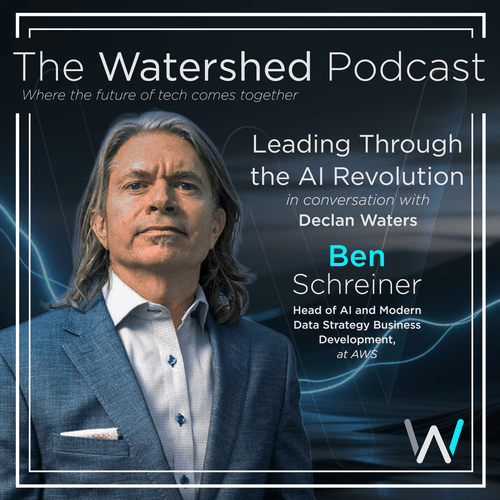
Episode 13
Leading Through the AI Revolution
Key Takeaways
AI is transforming industries at a significantly faster pace than previous technology revolutions.
Successful AI initiatives begin with solving meaningful business problems rather than deploying technology for its own sake.
Organizations need governance, security and clear guardrails to adopt AI responsibly.
Different AI models excel at different tasks, making model choice an important strategic advantage.
Leaders must balance rapid innovation with sustainable business outcomes and measurable return on investment.
Empathy remains a critical leadership skill as employees navigate uncertainty around AI.
AI is most valuable when it augments human capability by removing repetitive work and increasing creativity.
Continuous learning and curiosity will become defining characteristics of successful leaders in the AI era.
Ben’s Watershed Moment
Ben's defining watershed moment came when generative AI became accessible to everyday users through consumer applications.
Although he had worked with AI for many years across banking and AWS, he recognized that the arrival of tools like ChatGPT represented something fundamentally different. For the first time, AI had become simple, intuitive and widely accessible, opening the door for millions of people to integrate it into their everyday work.
That realization led Ben to pivot his own focus within AWS toward AI strategy, where he has spent the last two years helping organizations understand how to move beyond experimentation and build practical, responsible AI solutions that deliver measurable business value.
For Ben, this moment represents a technology shift on the scale of the internet itself—only happening dramatically faster.
Full Transcript:
Declan Waters (00:01.176)
Hello everybody, and welcome to the Watershed Podcast.
Today I'm joined by Ben Schreiner, who has spent 25 years helping some of the world's largest organizations decide where technology goes next.
He did it first as the person buying the technology, and now he's doing it as the thought leader advocating for the next stage of the technology evolution that we find ourselves in.
Today, he heads up the AI and Modern Data Strategy Business Development team at AWS. And he's also one of AWS's most in-demand keynote voices, a Safe AI Ambassador, a board advisor, a DePaul University Advisory Board member, and, by his own mission, still learning every day while trying to raise two nerds and strike the perfect balance between rock and roll and geek.
Ben, welcome to the Watershed.
Ben Schreiner (00:56.419)
Happy to be here, Declan.
Declan Waters (00:57.986)
Thank you, Ben.
It was actually a fun story how we met, wasn't it? Because our CFO, Holly Kenny, met with your lovely wife, Lara, who started a friendship, and then we met through that, which was fantastic. Small world.
Ben Schreiner (01:15.521)
Indeed, they felt that we had a lot in common and a lot to talk about, and here we are.
Declan Waters (01:19.774)
And here we are. They were so right, weren't they?
Well, thank you for joining us.
Before we get into the big stuff on AI—and there's quite a few areas I want to touch on with you—you, as I mentioned in the introduction, describe yourself as still learning every day, which I love, by the way, and trying to strike that balance
Ben Schreiner (01:22.817)
Indeed.
Declan Waters (01:44.428)
Professionally and personally, how's that going at the moment? Because I know a lot of people struggle with that. How are you finding it?
Ben Schreiner (01:51.446)
Yeah, I'll say right now my brain is very happy, very intellectually stimulated, because there's so much change happening in technology, specifically AI.
And I know probably many of the listeners out there, you know, it can be a bit overwhelming. I think I've given up on knowing everything. That's no longer the goal. I actually don't think it's achievable.
Instead, I'm just trying to continue to consume and grow intellectually. AI has opened up a whole new way of not just learning more about AI, but actually using AI to teach me things I'm interested in as a way to leverage the technology.
So I think it's really important, again, to keep the brain young. As a muscle, you've got to use it.
I encourage everyone out there to continue to read, continue to learn new things, learn new hobbies, whatever it is. But you have to make yourself uncomfortable in order to have growth.
I think, again, keeping our brains growing is key to longevity.
Declan Waters (03:03.455)
It's so true, isn't it?
Yeah, particularly that, you know, keeping yourself uncomfortable, which is not what we normally gravitate towards, do we, Ben?
But I think, given where we are at the moment, that's so important, isn't it? To feel that discomfort. Because, like you said, that's really how we grow at the end of the day, isn't it?
Ben Schreiner (03:22.337)
It is.
I think, as human beings, many of us say we like change, but I'd argue we really don't.
In our heart of hearts, we like comfort, we like routine, we like knowing what's going to happen next, we like predictability.
But the reality is, you know, that comfort isn't a place where you grow in any way, shape, or form, right?
So it's finding that discomfort, facing those fears, that's where you sort of level up in the game of life.
I think those who continue to challenge themselves, like you have with long-distance running, and Holly, which is just super impressive—I couldn't do that—but there are other ways to challenge yourself, whether it's a new job, a new client, or a new hobby.
I think it's absolutely critical to continuing to grow in your life.
Declan Waters (04:26.153)
Absolutely, Ben.
Well, talking about change, I'd like to just zoom out a little bit and, for the audience, frame the arc of your career so far. Because, as I said in the introduction, you've been on both sides of the coin here.
Maybe you could just kind of set the scene with a high-level overview of your career so far. I think that will help everyone understand your perspective on things.
Ben Schreiner (04:32.975)
Sure.
Ben Schreiner (04:53.601)
Sure. Yeah.
So I started out as an accounting major, of all things, and landed at a commercial bank, LaSalle Bank, in Chicago.
It was a great first job where you learned about how different companies operate, how they grow, and how they become profitable organizations.
Then I went to night school for my MBA at DePaul University when AOL went public.
I joke, Declan, that some of us are old enough to remember when the internet made a distinct sound. Everybody who's listening heard that sound in their head if you were active on the early internet.
When the internet became public and AOL went public, I was convinced that the internet was going to change banking.
I was in my early 20s, this new technology I was enamored with, and it really was a change.
Declan Waters (05:31.435)
Okay. Yes.
Ben Schreiner (05:55.682)
And so, as I got my degree, I decided to shift from being a commercial lender to being in the IT organization that supported the bank.
Many of my superiors tried to talk me out of it because I was on the revenue side of the bank. They were like, "Why do you want to go in the basement and work with IT?"
They didn't see what I saw, but I got support from the Chief Operating Officer and ended up being an international project manager for a while.
Then I did a couple of startups and really embraced technology, ultimately becoming the Global Head of IT Strategy at the bank that I once worked for and moving to Amsterdam with ABN AMRO Bank.
So I got to see a lot as the Head of Strategy globally. Then the financial crisis happened, and we split the bank into quarters for the four banks that had purchased the bank for $85 billion.
After that, I pivoted from one side of the desk to the other.
I got a job with Dell, which took us here to Austin, and had a variety of roles inside Dell. Then I moved over to AWS about seven years ago.
I'd say I had a similar watershed moment with AI.
So, two years ago, when AI got to our iPhones, I was like, "This is different than the AI I knew."
The bank had done AI. AWS had been doing AI for decades, but it was hard.
What ended up on our phones with that first ChatGPT app was different, and I knew I wanted to be a part of that.
AWS had numerous things going on, and over the last two years we've rolled out a number of products. Now you can get OpenAI and Claude on top of AWS.
I've been a part of AWS's AI journey for the last two years, again seeing it as a key transformational technology, like the internet was, call it 25 years ago.
Declan Waters (08:10.785)
Yeah.
I'm really interested in your response to this next question, Ben, because you travel the world.
I mean, just looking at your LinkedIn feed, I don't know how you get through everything because you are constantly on the move.
You're speaking to thousands and thousands of people every year during your keynote addresses. You're meeting customers, you're meeting prospects, and you're talking to all of the brilliant minds at AWS every day.
How would you characterize why this moment is different?
We've heard about your career. You've seen many, many huge changes in technology. But why do you think this moment is so different to the previous ones that we've seen?
Ben Schreiner (08:57.037)
Yeah.
So, just think about the internet and how it changed banking. I mean, when's the last time, Declan, you were in a branch office for any reason, right?
But the reality is, while I identified that it was going to change, it took a very long time. I would argue 15 to 20 years to really adopt the different transformations in the banking world.
Declan Waters (09:06.123)
Yeah, exactly. Yeah.
Ben Schreiner (09:25.419)
This AI movement and transformation is changing things faster than the internet did.
So I think it'll be as profound, if not more profound, but it'll happen in a compressed time horizon.
The reality is, the amount of investment has never been seen before. I mean, we're north of $200 billion just this year that we've committed to invest.
We've invested, as AWS, for the last several years more than any other provider in this technology, both in our own chips as well as the data centers to support the needs of model providers like Anthropic and OpenAI.
So the amount of investment is high, and the amount of demand is very high.
Then, just as a technologist, Declan, I tell people that the thing that is most profound is that most people have had a personal experience with the things we can do with this technology. Fundamentally, they were not possible two years ago.
Declan Waters (10:32.166)
Mm-hmm. Yeah.
Ben Schreiner (10:34.595)
That watershed moment is that AI is easy.
AI has been around for decades, but it wasn't easy.
Now we've made it consumer-grade, consumer-consumable, and that is awesome.
Now every professional is trying to figure out, "How do I take this consumer thing and bring it into my work life?"
That creates a different challenge for the Chief Security Officer because you have to protect your data. You don't want critical intellectual property leaking out or going in to train the next model.
It creates governance needs over the agents that are being created and what they can and can't do.
At the bottom of my emails, I state the famous Uncle Ben quote from Spider-Man: "With great power comes great responsibility."
I do believe that.
Declan Waters (11:32.043)
Mm.
Ben Schreiner (11:34.499)
We have this tool that we're all trying to figure out how to leverage, but we also have to do it in a responsible way.
Declan Waters (11:40.758)
Yeah.
In terms of that responsibility, what are you hearing from boards at the moment?
Some of the guests we've had on recently have talked about this FOMO that's out there at the moment, where companies are petrified that their competition is going to adopt the technology faster and roll out the use cases quicker.
Ben Schreiner (11:55.245)
Yeah.
Declan Waters (12:06.037)
You've talked about other companies in the past, like Netflix, and how they moved so quickly and took out so many competitors.
I think now, with AI, there's this rush to move forward and to say that we have AI delivering value.
But you've also talked about this need to pause, even when it's moving so quickly, to take stock and build that more sustainable path to success.
So what are you hearing out there in terms of the speed of this?
Ben Schreiner (12:38.231)
Yeah.
I mean, the speed is going faster than anything before it.
Rightfully so, right? The optimism that the board has, or the paranoia that the board has, is well founded.
This tool will be the catalyst for the success of companies going forward. So figuring out how to master it is very important.
And how to get value out of it. You said it, Declan, how to get value out of it.
I would argue that, for the last two years, everybody's been in a hurry to do AI and get something out there.
Then you're starting to see lots of people publish, "Well, I'm not really seeing the value," and so on and so forth.
I would argue many were in a rush just to tick a box.
That isn't going to be transformational. That's not going to create a competitive advantage.
The reality is, whether it's the board asking the questions of the operating company or the operating executives, they really need to figure out how this tool helps us solve whatever problem we solve in the market, or make our customer experience better than it ever was so we can attract more customers and retain the customers we have so we can grow our business.
Ultimately, it's a tool.
We all have to learn how to use the tool and maximize its value.
But it starts with, "What problem are we solving?"
It's not enough just to put a chatbot out there. You could get some value out of that, don't get me wrong, but I would argue that every leader listening to this needs to figure out:
What problem are we solving?
What data does AI and the system need to solve that problem?
Then look at what technology is best suited to solve it.
Right now, I'd argue that most folks are taking the biggest, latest model and throwing everything at it.
Declan, you know this as well as anyone. Not all problems are created equal, and not all problems are the same size.
So if you take a very small problem and you're feeding it to this big, expensive model.
Declan Waters (14:36.941)
Mm-hmm. Yeah.
Ben Schreiner (14:50.273)
That's not a great return on investment.
I foresee, and we foresee, that you're going to have folks using lots of different models—different-sized models—because they're good at different things.
Your ability to choose the right model and navigate, or broker, the right responses is going to be the key to balancing the return on investment and getting optimal value out of what you're investing in.
We're starting to see companies realize that and start to architect how they leverage these models and how they give access to the models in new and different ways to dial in that return on investment, which, Declan, should have been there all along.
I think, in the exuberance, people forgot some core best practices.
I think we're getting back to those.
It's just: What are you trying to do? What's the best way to do that? Then have a plan and execute it.
We're seeing people execute that cycle a whole lot faster than maybe in years past.
I think annual planning is going to be a thing of the past, and you're going to have to check in quarterly to make sure you're headed in the right direction or going fast enough.
Declan Waters (16:08.685)
You've talked about governance and responsibility, and you talked about the AI framework.
What caught my eye was the cookie recipe test. It sounds like a government's blueprint, but explain to us what you mean by the cookie recipe test.
Ben Schreiner (16:20.449)
Yeah, yeah, yeah.
Ben Schreiner (16:30.637)
Yeah.
So, for everyone listening, you're not going to get the benefit of the cookie visual.
I have a slide with two delicious chocolate chip cookies shown, which instantly makes the audience hungry, which is great.
But the cookie test is this, Declan.
Back to my belief that many rushed to do AI.
They put a corporate chatbot out there, and there were many providers who were just happy to give them something so they could tick the box that they did AI.
I ask you, if you have a corporate
Declan Waters (16:43.565)
Yeah.
Ben Schreiner (17:04.129)
...chatbot to ask it for a chocolate chip cookie recipe.
I usually get the puppy-dog look back, like, "Why are you asking me for that?"
The answer is, unless you're in the business of creating chocolate chip cookies, your corporate AI should not give you an answer.
If it does, it could indicate that your IT team, or whoever put it out there, didn't put the appropriate guardrails or harness around AI to tell it very specifically what it can and cannot do on the company's behalf.
The reason this is super important is for boards who are all about governance and making sure that nobody wants to go to jail.
Declan Waters (17:40.033)
Mm. Interesting.
Ben Schreiner (17:54.632)
The reality is, if somebody does something bad, the first thing that, here in the US, the FBI does is go and get the person's laptop or computer and try to figure out why they did the bad thing.
What you do not want, as a board of directors or as a senior executive, is to have your corporate AI feed a person instructions or how-tos to do a bad thing.
The cookie recipe is a very innocent question, but I've got a bunch of more nefarious questions.
The cookie recipe does highlight the need for guardrails because, at the end of the day, if your people are using your AI to do things that are not related to your business, they're wasting time and they're wasting money.
Every question costs tokens, and eventually we all have to pay for these things.
You don't want to waste time.
You also do not want to open up your organization to any undue risk.
The cookie test is a very simple one just to see if the guardrails are there.
If you get a cookie recipe, it doesn't mean the sky is falling, but it does mean you should have some questions for your Chief Security Officer, or whoever deployed AI, to ask:
"Hey, what all can this thing do, and what guardrails do we have in place?"
Declan Waters (19:12.081)
Mm.
Very sound advice, Ben. Thank you.
You mentioned the people there as well.
I just want to step away from the technology for just a moment and talk about empathy, which you've spoken about a lot. It's maybe an underrated skill right now because everyone is so focused on the technology component.
Any good leader needs to bring their people with them through any transformation.
A company is only as good as its people, and I still believe that right now. Who knows where things are going to lead in the future?
But what does that look like to you?
You're a leader at AWS. You've led people all of your career.
What does leadership mean to you right now in the AI era?
Ben Schreiner (19:44.728)
Indeed.
Ben Schreiner (20:03.139)
Yeah.
I think, as leaders, we have to acknowledge the fear that exists.
There are many people who are afraid that this technology is going to take their job. That is a real human reaction to change.
As leaders, I think we're best served to use empathy to understand, and better understand, why our people feel that way and to do what we can to help them through this transformation.
I like to say that AI is absolutely amazing, and I do think it will automate tasks for us.
But I joke, Declan, and I talk to lots of heads of HR about this: How much of your job is actually in the job posting that you applied for?
I mean, is it half? Is it three-quarters?
It's certainly not all the things you..
Declan Waters (21:00.203)
Mm-hmm.
Ben Schreiner (21:06.577)
You do were written on the piece of paper or the job description.
To think that AI could replace an entire job that isn't even well documented is going to be quite difficult.
Certainly, tasks inside the job can be automated.
The other thing I like to reassure people about is that AI is going to be used to solve problems.
We're going to be able to solve problems faster with AI than ever before.
But I have the utmost faith, Declan, in the human race that we're going to find more problems.
I don't think for a second that there are going to be fewer problems in the future, but I do think this new tool is going to allow us to solve problems faster so that we can get to more complex, harder problems—harder challenges—that maybe we wouldn't have been able to get to without this technology.
So I'm very bullish and optimistic that AI is going to allow us, as humans, to have a bit of a renaissance when it comes to creativity.
I think I shared with you that I use it. There are things I want to be able to do, but I don't have the skills to do them.
My lovely wife has a great vision for her website, and I said, "Why don't you use Claude to design it? Once you've got it all designed, I'll help you get it published so that the rest of the world can see it."
That was infinitely faster for her to get her vision out of her head.
Then, for me as a technologist, I had exactly what she wanted and just made it available.
That was much better than her trying to describe it using words and me trying to code it into a web page.
I think this is going to allow folks who are not technically inclined to do infinitely more things.
It's going to allow technical people to have a way of coding faster and orchestrating agents on their behalf.
The last thing I'll share with you is that I've said this before: as a people leader, I think, Declan, our generation of managers is the last generation of managers to manage just people.
Ben Schreiner (23:20.343)
Like human beings. I think we're going to manage human beings and agents that are doing tasks within our remit or our responsibility.
You're still going to have to have oversight over those agents to make sure they're doing the things that you want them to do.
You may have to have performance reviews and retraining of those agents when they don't do what you want, just as you would a junior employee.
Declan Waters (23:44.052)
Mm-hmm. Absolutely.
I know you enjoy mentoring, don't you, Ben? Future CIOs, people just starting out.
I'm curious, on a more personal level, to ask you: If you were Ben, going back to 25 years old, just getting into your career, what would you have wished someone had told you?
Ben Schreiner (23:57.391)
Sure.
Declan Waters (24:12.127)
Right, that you know now of all the wisdom that you've accrued, you know, over the course of your career. Are there one or a few things that you wish someone had told you when you were starting out?
Ben Schreiner (24:21.967)
So, I'll say this, Declan, because I remember my 25-year-old self.
I was with a very senior official at the bank, and he asked me, "What are you passionate about?"
I told him, and he said, "You should pursue that."
It was great advice, but I'll admit, as a 25-year-old, it didn't land.
As a soon-to-be 54-year-old, I look back and realize that was great advice. But my 24-, 25-year-old brain just didn't know what to do with that.
While I could provide the best advice, it would be to pursue your passion, trust your gut, and find things that are of interest to you because I think that is in line with passion.
Your job should be fun, right? Not all jobs are fun, and I do think it's our responsibility to make our jobs fun.
If you can, then it doesn't feel like work.
I encourage everyone—every job probably has 20% of it that you really wish you didn't have to do, but you have to do because it's just necessary.
If you can get AI to do that 20%, that part of the job you really don't care much for, or help you with it—maybe it can't do all of it, but if it can alleviate the burden of the part of the job you don't like the most—it allows you to have more time to do the part of the job you like the most.
To me, that shifts the balance in happiness, or job satisfaction.
That's really what I hope for everyone: use this tool to help you do whatever it is you want to do faster, better, and have more fun at work.
Declan Waters (25:52.845)
Mm-hmm.
Ben Schreiner (26:14.011)
Okay.
Declan Waters (26:14.593)
Yeah, great advice, Ben.
I know we both go on podcasts a lot, and we both enjoy listening to podcasts.
We're both big Simon Sinek fans as well.
Who else do you listen to these days?
You're doing a lot of traveling. Which are the voices that you listen to to help you understand this new world that we're getting into right now?
Anyone spring to mind?
Ben Schreiner (26:26.209)
Indeed.
Ben Schreiner (26:39.907)
So yeah, I consume the AI Daily Brief.
Declan Waters (26:45.697)
Yeah.
Ben Schreiner (26:46.499)
They do a very good job of synthesizing all of the announcements. I think that's great.
We have an internal podcast as well that I listen to, just to keep up with the changes inside our own organization, which is moving very fast.
I tend to hop around quite a bit.
There are several around investing that I'm curious about, but The AI Daily Brief is probably the one, from a technology point of view, that I've listened to pretty consistently.
Declan Waters (27:24.257)
Yeah, fantastic.
We've covered a lot of ground in a short period of time, but the last question I wanted to ask you, Ben, was: Is there anything I should have asked you about what's happening with AWS right now?
I go to the re:Invent conference every year. It's one of the best shows for Waters Agency and also for our clients. I love attending it.
There's so much innovation and so much going on at AWS. Is there anything you wanted to point out to the audience that they should keep an eye on?
Either stuff that's happening right now or stuff that we should maybe look forward to later in the year.
Ben Schreiner (28:01.549)
Yeah.
I'll say this. Most people don't really appreciate the layers of investment we're making, whether it's in the chips for training and inference that consume less water and power than some of the other chips available in the market, while also giving us more capacity to serve our customers' needs.
We've had a different strategy than some of our peers, who are now copying our strategy, which is the best form of flattery.
Our strategy is to have as many models available for our customers to choose from because we believe in the power of choice and competition.
We also believe that models are good at different things, and we want to make it possible for you to compare models with each other and evaluate their performance so that you can make the best choice for your use case.
At the highest level, we've made investments in making AI easy.
If you don't want to get into all the gory details and you just want to use it, we have a call center offering, an HR offering, and a decision and logistics supply chain offering that are all born out of our use of AI to solve our own problems at our scale, which we now make available to our customers.
Lastly, I'll say I see innovation happening at two layers.
There is the enterprise layer, and then there's the individual knowledge worker, like you and me.
You have your organization, Declan, and then you have you. Those are two different paradigms, or levels, where innovation can happen.
We released, a little over a month ago, Amazon Q, which is a desktop application for Mac or Windows.
Ben Schreiner (30:01.521)
That does something pretty unique.
It creates a knowledge graph for you, the knowledge worker.
It plugs into your email, your Slack, and your calendar, but it also plugs into your Downloads folder and any other files you give it access to.
I told it what my team is, who my people are, what we do, how often I have to produce reports, and what they look like.
It has all this context about me and my job, and it's become my executive assistant.
I start every day with "Start my day," and it tells me what I didn't get done yesterday, what my calendar looks like for the day, and any urgent Slack messages that came across.
It helps me be more productive.
It's been a fascinating unlock for me.
It helps me write emails, keeps me on task, and is great for reminders.
The other cool thing—I don't know about you, Declan—but I create a lot of content, and I can't remember where I saved it or what I called it.
I have bookmarks all over the place. Where are the things that I think are valuable?
Inside Amazon Q, I can just say, "Hey, I developed a PowerPoint. The topic was this," and it'll search semantically through everything and surface what it thinks might be the file.
That's infinitely faster than me trying to dig through my Documents folder, which I will...
Declan Waters (31:02.818)
Mm-hmm.
Ben Schreiner (31:31.311)
...looks much like my attic at home. It's not very well organized.
It's allowed me to save time and energy, and it's been a godsend for my productivity.
Declan Waters (31:44.085)
Yeah.
Just listening to you talk there, Ben, has made me realize there's so much more I could be doing to optimize my time.
We've talked about this when we've met up, and there's so much more that people can be doing.
So thank you.
Thank you for sharing that with us.
I really appreciate you sharing your wisdom.
Ben Schreiner (32:03.983)
You're very welcome.
Declan Waters (32:13.985)
Your insights, what you've been hearing and seeing while talking to so many people on the road, have been invaluable.
I can very clearly see why you are such a popular keynote speaker on the circuit right now.
We need more people like you in the industry who can help simplify what's going on right now, but also inspire.
I love the way you keep pushing companies to think bigger, and individuals as well when it comes to this, which I think is a message we all need to hear.
So thank you so much, Ben.
As a friend and a colleague, I love what you're doing.
Keep doing it, and I hope to see you again soon, my friend.
Ben Schreiner (32:58.059)
I appreciate you. Thank you for the opportunity. It's an amazing time to be alive and in technology. So seize the moment.
Declan Waters (33:04.415)
It sure is. What a great night to leave it on. Thank you then.