
Episode 12
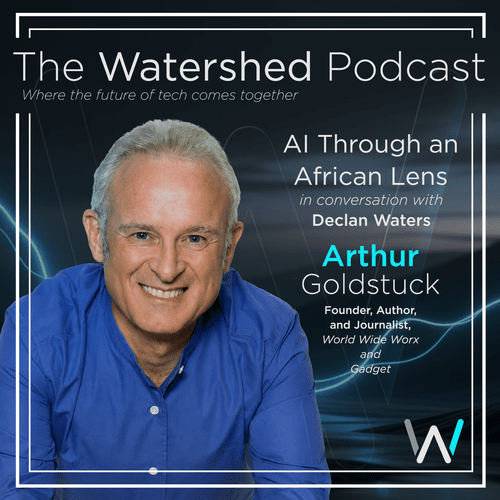
AI Through an African Lens
Key Takeaways
Africa approaches AI through the lens of solving practical problems rather than pursuing technology for its own sake.
Organizations that innovate under constraints often develop stronger, more practical solutions.
Successful AI adoption requires balance between experimentation, governance, and business outcomes.
Shadow AI presents growing governance and security challenges for enterprises.
AI will transform many knowledge-based professions, but expertise, creativity, and judgment remain difficult to replace.
Quality journalism continues to create value despite rapid technological change.
Curiosity and lifelong learning remain essential for navigating every new technology wave.
Technology delivers its greatest value when it helps solve real human problems.
Arthur’s Watershed Moment
Arthur's defining watershed moment came in 1995 with the publication of The Hitchhiker's Guide to the Internet.
After writing several successful books on urban legends, Arthur caught the attention of a publisher through an article describing how he'd used the early internet to research one of his books. Although internet adoption was still limited at the time, the publisher believed demand would grow.
Together they published The Hitchhiker's Guide to the Internet just as public interest in the internet exploded.
The timing transformed Arthur's career, establishing him as one of Africa's leading technology commentators and setting him on a path that would see him chronicle every major technology wave - from the internet and mobile to cloud computing and artificial intelligence.
Full Transcript:
Declan Waters (00:01.9)
Well, hello everybody. I'm Declan Waters, and welcome to The Watershed Podcast.
Today's guest has spent some twenty-five years researching how technology actually lands in Africa, and he's documented it and had a front-row seat pretty much from the beginning of the internet boom.
He's founded World Wide Worx in 2000 and has written more than 20 books, including two on AI, and that was before anyone in South Africa was really taking notice of the technology.
Arthur has been charting technology for many, many years. We met when I was working at VMware, and Arthur was coming to Barcelona every year to chart the company's progress. I'm absolutely thrilled to talk to him again today on the podcast.
So, Arthur, a warm welcome. How are you?
Arthur Goldstuck (01:04.196)
Thank you, Declan, really good thank you and it's a great time to be chatting with you as well.
Declan Waters (01:09.972)
It really is. We've got a lot to get into, so thank you again for joining us from South Africa today.
I just wanted to first touch on your recent experience of going to the World Cup opening ceremony and the opening game. I think you're the first person I've actually spoken to who's actually done that.
So maybe you could just tell us, how was it? How was the experience for you?
Arthur Goldstuck (01:35.041)
It was an enormous privilege to be at the opening game of the World Cup.
Because it is the opening of the World Cup, I'm a massive football fan. When the World Cup was in South Africa in 2010, I went to 10 matches, including the final. But I didn't imagine I'd get to the opening game of one of the tournaments beyond South Africa.
And going to the Azteca Stadium in Mexico was an iconic moment in an iconic venue. I was a guest of Lenovo, who are the technology partners of the World Cup this year. So it was an opportunity to see firsthand how the technology was making the World Cup experience seamless.
And there are a lot of stories around the technology they're using for player tracking, ball data, video feeds, and the like. But my direct experience was how seamless the entry into the stadium was and how well the ticketing worked through a mobile app, on which you downloaded a QR code that they sent you on the morning of the game, which, in the past, you would have thought, "That's really taking chances."
But it facilitated getting into the stadium so comfortably that I kept thinking, "The other shoe is going to drop. Someone's going to stop me, or I'm going to find myself in a line to get to my seat or something."
Nothing like that happens. So it was a delightful experience from a logistics point of view, but the atmosphere was indescribable, and it was a deeply emotional experience as well.
Declan Waters (03:16.93)
Yeah, isn't that fantastic?
Are you going to be writing about the experience? 'Cause I'd love to read about that if you are.
Arthur Goldstuck (03:28.888)
I've written a column. I do a weekly column in the Sunday Times in South Africa and my column this past Sunday was about that very experience, but I'm sure I'll be writing more.
Declan Waters (03:33.559)
Okay.
Declan Waters (03:36.998)
Very good. I'll put that in the show notes, I'll put that in the show notes, Arthur. Yeah. Fantastic. Well let's start from the beginning, 'cause I'd love to introduce you properly to the Watershed audience. You started out as an investigative journalist at The Mail and Guardian.
Which is kind of different training in some ways, you know, for a technology analyst. So I'm curious, maybe you could give us the high level story arc for Arthur Goldstuck to introduce yourself to the Watershed audience.
Arthur Goldstuck (04:18.518)
I've always worn many hats as a journalist, a researcher, as a speaker as well.
But it started with a passion for science fiction, which led to me constantly looking for opportunities to write about technology. But I also had a deep curiosity about the world.
My first books were about urban legends. And those were an attempt to almost to try to understand how the world actually worked. And that, in a sense, influenced my involvement in investigative journalism as well. I became news editor of The Weekly Mail, which was a predecessor to The Mail and Guardian.
I led a team of investigative journalists there. But I found that work was not very different to the work I did in Urban Legends. It was basically uncovering the nature of reality, you could say.
And the connection between that and technology was fairly seamless for me because I simply applied the principles of investigative journalism to technology journalism and to try to understand how technology worked. But more from a point of view of how people used it, then what it was technically.
And I think that was the secret of the trajectory of my career was that I was able to demystify the technology in the same way I try to demystify urban legends, in the same way I try to demystify current events. And applying that to technology, me entitled completely different voice from anyone else writing about technology in this environment.
Declan Waters (05:51.304)
We were talking before we went live on the podcast, Arthur, about my feeling that people like yourself, who have had this deep understanding of technology over the last twenty, twenty-five years, are so important now as we try and demystify AI and what's happening over the next ten, twenty-five years.
Your second book on AI argues about Africa playing a role in AI, and I want to get into that. What's your view on AI in general?
I want to get your thoughts on that, but also maybe drill into Africa, where you're from as well. What are your thoughts on those two areas?
Arthur Goldstuck (06:45.892)
The Africa angle is very significant to my understanding of AI and my views on AI as well.
The fundamental difference between how AI presents itself in Silicon Valley and how it does in South Africa, and across the African continent, is the way I put it in my book: in Silicon Valley, it's all about opportunity.
Across Africa, it's all about need and addressing challenges.
When you have that filter, you take a completely different approach to AI. You're not looking at AI as the end of humanity because it's doing away with employment. You're looking at AI as the beginning of opportunity because it makes so much possible.
In South Africa, we have something like a third of the working-age population unemployed. So taking away jobs is something that's already been happening as a result of mismanagement in government departments and as a result of labor being exceptionally militant and discouraging people from wanting to employ too many more people.
AI comes along and suddenly makes employment viable for individuals doing their own thing.
Now, in what I've said there, there are a lot of ideological nuances that one can bring into it, but that's the broad picture as I see it relating to AI.
But here's the real issue, or the real takeaway, in terms of AI in Africa.
The big advantage, which is also the big disadvantage, of Africa is that we operate under constraints, so we have to innovate under constraints.
That means organizations have to focus on practical outcomes, solving challenges, addressing challenges, and finding solutions, rather than investing in shiny technology for its own sake.
If you think about it, the idea of having to innovate under constraints and focusing on outcomes is actually the mindset that's needed to succeed with AI. It's also the mindset that takes you away from the perspective of AI as an apocalyptic force.
Declan Waters (09:20.158)
So how do you view AI in terms of zooming out and looking at the bigger picture, Arthur, in terms of how it's going to affect all of our lives?
What's your thinking? You get people that are very optimistic. You get people that are very worried and frightened about AI and the impact it'll have on them professionally and personally.
Where does the pendulum land for you?
Arthur Goldstuck (09:47.503)
Those who don't use AI are far more fearful of it than those who do.
You do have the fearmongers who are experienced AI practitioners, researchers, and the like. You even have Nobel Prize winners who are warning about AI being potentially the end of humanity. But broadly speaking, if you were to do a poll, you would find that those who don't use it, generally speaking, are the most fearful.
But the lens through which I've seen it more recently is a fascinating one that is not what you would normally read about AI. And that is speaking to retired people about what AI can do for them.
I give a lot of talks, and some of these talks are for groups of retirees. There's an organization called the University of the Third Age, with the Third Age being the retired age, the Second Age being the working age, and the First Age being the school age.
The Third Age is retired people.
Speaking to the University of the Third Age is fascinating because these are all people who are typically over 70 years old.
The approach I take to some of these talks is to ask my audience, "What unfulfilled ambition do you still have in life?"
You'd think that's a strange thing to ask retired people.
But especially there, you have people who either have regrets or wish they could still do things in their lives.
So I ask the audience to give me examples, those who are willing to share.
Then I show them how AI can address those needs or ambitions.
In some cases, it meets their expectations. They were hoping that's what I would be telling them.
In other cases, they are astonished at the extent to which AI seems to appreciate exactly what they are wanting to achieve and gives them guidance or a structural framework on how to get there.
What it highlights for me is how AI is an augmentation force, or a force for augmentation, for people of any age, of any capability, and at any stage in life—financially, professionally, health-wise, etc.
It can transform your health, for example, if you use it responsibly and you're willing to take guidance and allow it to establish a framework for you.
So that's just a broad perspective to almost repeat a cliché about AI, which is that it's more about augmenting people than replacing them.
But it's a very glib statement simply to say that AI will augment us rather than replace us.
However, when you look at it through the lens of people who are facing challenges in life, and you look at it through the lens of ordinary people and what it can do for them, you suddenly realize the practical meaning of the idea that AI can augment anybody.
It's not just about one thing. As AI likes to say, it's not just this, it is that.
But it's not just about making you better at what you do.
It really can open vistas for you that you never imagined were possible.
So the opportunity, the potential, and the vision that it opens up are infinite.
Declan Waters (13:38.17)
Mm. As a writer, and clearly a deep thinker on these subjects, Arthur, I'm curious how you're using AI personally and professionally yourself.
How does it show up in your life at the moment?
Arthur Goldstuck (13:57.997)
It's hard to give one answer to that because I use it in so many different ways.
One of the fun things I do nowadays is someone says, "I wonder..." and they'll make a statement. Like when I was in Mexico: "I wonder how many people speak English in Mexico. I wonder how many people are not Catholic in Mexico."
It's just people musing, and you might have done a Google search in the past, and you might have come up with a hundred results and not known where to actually go. But now AI Mode instantly answers these kinds of questions.
Now, Gemini and Google's AI Mode are not the most reliable. They've just been sued for that very reason.
But for casual conversation, it's fantastic for just quickly addressing those kinds of questions.
But talking about Mexico, I used it in a number of different ways on this trip. And one of them was to ask it to find a restaurant where I could eat a very specific Mexican dish I was looking for.
And I had to argue with it quite a bit because it was trying to AI-splain. I call it AI-splaining when AI tries to give you too much information that you're not looking for.
But eventually it took me to the places that...
I really enjoyed what I had. And also, in one case, where I saw a kind of hole-in-the-wall eating place, I thought, "I'd love to try it, but let me just find out what people have said about it."
But rather than do a search and go looking for reviews, I simply asked, in this case, ChatGPT to tell me what people say about this particular place. And it actually gave me very positive input.
I asked for the links as well to where it found that, just to make sure it wasn't making it up.
And then I also asked it to give me a route from where I was—what Americans would call a route—to get from my hotel to a very specific location I wanted to go to, which is in quite a dodgy part of the city.
And it was something like a half-hour walk, but I wanted to experience an authentic eating place along the way. I wanted to experience street art. I'm a big fan of street art as well, especially in new cities.
And it gave me a route to experience all of that on the way to this particular location, and it was a fascinating experience.
So I don't say I couldn't have done it without AI, but AI certainly facilitated the tourism experience of Mexico City.
And people say AI is great for producing itineraries, but this was a case of using it on the go while I was actually immersed in the environment, not planning something in advance.
And it was far more effective than constantly searching for reviews or who has done this before, because you don't find that kind of thing. AI puts it together for you.
So those are different ways.
I also use it in very obvious ways, of course. I use it for researching information.
When I wrote my column about how technology was used in the World Cup, I did a lot of searching just to double-check certain information.
And then one of the reviews I wrote from Mexico was... We do car reviews in my online magazine, Gadget. And one of the reviews I wrote was of the Uber Planet service that they have in Mexico.
They have it in a few other countries as well, but I had never seen it before. We don't have it in South Africa.
And it's a kind of carbon offset program that Uber has. But the car that fetched me was an electric car from BYD, which is a Chinese brand that is in South Africa. But this particular car I had never seen or heard of before.
And I asked AI about it, and it gave me this fascinating background of this car that had been designed specifically for ride-hailing by BYD in collaboration with a Chinese ride-hailing company called DiDi, which is also big in Mexico.
And it gave me so much great information that it actually enabled me to write a review, which appears in Gadget at the moment, on a passenger review of being in an Uber Planet car built by BYD for DiDi.
It was a fascinating insight that I would never have received, or never have been able to give, without AI giving me all that background information and research.
So it's an incredibly powerful source of information and confirmation as well.
And what I do is, if I get that information from ChatGPT, I'll ask Claude to fact-check it for me because, by themselves, they are quite unreliable. Or at least ChatGPT is. So is Gemini.
Claude tends to be very businesslike and will tell me if the information is wrong. It's the only one that actually will admit that it cannot find the information, for example.
Whereas if ChatGPT can't find the information, it'll make it up. Same with Gemini, for that matter.
So you've got to use multiple AIs to do your fact-checking for you as well, and that's an important part of my writing as well, to use AI for fact-checking.
Declan Waters (19:34.424)
Yeah.
Declan Waters (19:45.262)
I hear you on the facilitation. I was in Cape Town last year, and it's such a beautiful city. I don't need to tell you that, Arthur.
I was visiting our mutual friend Charlene and her sister, Tracy, who I work with, and I had a free day before I flew back to London.
I used ChatGPT to give me a full-day itinerary based on what I like to do. It was just incredible what it came back with. Even on the tourist bus stops, what to see, what not to see, perhaps based on reviews.
I had such a fantastic day, in large part because of ChatGPT. And obviously Charlene and Tracy gave me pointers here and there. But it's so great, isn't it, in those situations, to be able to use the technology.
Arthur Goldstuck (20:36.59)
Yeah, exactly.
I'll give you another very quick example that is not an out-of-the-way place.
Atlanta Airport. I had a five-hour layover on my flight back, and I asked Claude and ChatGPT to give me some advice on how to spend the time.
It was spot on. It was really so good.
And knowing, or having a sense by now, of what my interests were, and what I would like to do, and what I would like to eat, it really gave me fantastic advice.
It also told me what not to do, which was probably just as important.
Declan Waters (21:07.945)
Mm-hmm. Yeah.
What's your feeling—and I want to just touch on business and enterprises—what are you seeing on the AI adoption curve with African enterprises?
I was at an insurance AI conference, actually, in Boston just yesterday, and they were saying that it's a very complicated industry, of course, highly regulated.
Bringing AI into environments like that is going to take a lot of time, right?
The sense I was getting from the panel was there's this fear that companies are being left behind because the models and everything are moving so quickly.
It's like, "Our competitors are doing it. We aren't. We've got to get going."
And that's why a lot of the pilots aren't working. They're making mistakes.
What's your sense of what you're hearing on the ground in Africa, but also in your travels in the U.S. and other countries?
Arthur Goldstuck (22:21.38)
We've actively researched the topic in South Africa.
We do an annual study on the generative AI landscape in South Africa, and we saw a massive increase over the past three years in adoption of AI.
Well, from 2024 to 2025, it went from something like 42% to 65% of companies using AI in one form or another.
But at the same time, the research showed a very high proportion of companies where they were experiencing what's called shadow AI, which means staff members of the organization are using AI under their own auspices.
They're using their own credit cards to sign on, or they're using free AI without any oversight from the company itself.
That's one-third of companies reporting shadow AI, and that's a massive threat from a security point of view, but also from the point of view of when they use dodgy AI, or they depend on AI for the last word instead of themselves having oversight over the AI.
The reason it's important for leaders to have oversight over how AI is used in their companies is to ensure that the human beings using the AI also apply that kind of oversight, which is surprisingly common to find not happening.
That's why, for example, law firms are often finding themselves in trouble because lawyers who are under pressure are using AI to write arguments for them and inventing case law, for example, which is disastrous for a law firm.
But that's because there isn't proper leadership oversight from the top down.
So that's the downside.
The upside is that companies are experimenting at the moment to a large extent. Once the experimentation shows powerful results, you're seeing a very quick move, especially in South Africa, from experimentation to formal implementation.
That's where you see organizations appointing a Chief AI Officer, for example, which is starting to happen in South Africa.
In big organizations, it's becoming almost taken for granted that you have to go that route.
But it's not about AI for its own sake. It's about finding the use cases, finding the justification, and then realizing the impact it can make on the business.
It surprises me how many businesses go to one extreme or the other.
The one extreme is where they instantly think AI is going to change everything, and they fire their marketing department, for example, because they think AI can do marketing for them.
Those are companies that will go out of business because they're trying to be so far ahead of the curve that they don't actually know what the curve is.
Then the other extreme: companies that are so terrified of it that they won't use it. Their competitors use it to run rings around them, and they will also go out of business.
So you've got to strike a happy medium.
You've got to be balanced in your approach, and you've got to sit somewhere on that learning curve.
Declan Waters (25:49.984)
Wise words. Very wise words, Arthur. You definitely need a balance there.
How do you think about what's happened over the course of the last 30 years, but going back further, with the advent of new technology?
I mean, just recently I read an interesting story about the advent of the ATM.
When the ATM was built for the first time, everybody thought that nobody would need to go into banks anymore. That'd be the end of banks.
Actually, it created the opposite effect.
Yeah, the ATM was widely used—not initially—but then, actually, people went into banks much more. They just went in for higher-value tasks, you know, to talk to their bank manager, talk about loans, et cetera, et cetera.
So actually, you created more foot traffic for the banks because of the ATM.
We've seen disruptive technology have the reverse effect.
How are you feeling about jobs now in AI? There's a lot of talk about data entry jobs.
The AI CEOs seem to be flip-flopping between, "This is going to kill lots of jobs," and then kind of reversing their position on that.
What are you thinking in terms of jobs over the next five, 10, 15 years?
Arthur Goldstuck (27:10.692)
It's not popular to say that AI will create more jobs than it'll kill, especially if you're an AI giant and you don't want to scare people.
But I'm afraid that is misleading.
It makes me think of where I was at, what my own position was, rather, when I wrote my first AI book in 2023.
It was subtitled A Handbook for All. That's the book over there, The Hitchhiker's Guide to AI, subtitled A Handbook for All.
I fell for that same argument that AI will create more jobs than it'll kill.
I quoted the World Economic Forum showing the projections of how many jobs will be created versus how many will be destroyed.
Then the subsequent data from the World Economic Forum was more about how it will change jobs than how it will kill off jobs.
I think they themselves were trying to avoid scaring people.
But by the time I wrote my second AI book, which is also called The Hitchhiker's Guide to AI, but subtitled The African Edge, I'd become more realistic and practical about it because I was seeing how AI was killing off jobs, especially in areas like graphic design and other areas where ordinary people suddenly could do things with AI that they never could before, that they needed specialists to do for them in the past.
That made me realize that there are going to be massive categories of jobs that will be killed off very fast before they augment the people who are doing those jobs in order to do other jobs.
What I will say is that the people who are at the top of their professions in these segments will become even better.
They'll probably become even more successful.
They'll be in more demand because to be really good at something like graphic design—I mean, when I say really good, I mean to be one of the greats—is not only about the design work itself.
It's about understanding the client.
It's about having an appreciation of the aesthetics, etc.
All elements that would take massive prompting to get AI to do right.
So if it takes pages and pages of prompting to replace you, then you probably aren't going to be replaced because one of the funny things that happens with AI is the more prompting you do, the more likely it is to get confused and to mess it up.
That's one of the dirty secrets I've discovered of AI prompting.
But just to address that question more directly, manual labor is not going to be affected in the short term.
I don't believe that AI-powered robots are going to become accessible and affordable enough to be able to replace manual labor for decades to come, if not generations.
But in terms of information workers, there are so many categories that are going to disappear because of AI.
What we're already seeing is companies trimming their workforces and blaming AI for it, where, in fact, it's just an excuse for cutting the workforce in order to maximize profits.
But the moment AI can help them maximize profits by reducing headcount, they will use it for that purpose.
There's absolutely no question because the typical company that is on the stock market has the approach of serving the shareholders, not their workers and not society.
The purpose is to maximize profits, and to maximize profits you've got to minimize costs.
AI, in the longer term, is going to be an incredibly powerful minimizer of cost.
So I do see it, from that point of view, being incredibly damaging to the jobs market.
In the short term, if you look at the unemployment rates in the United States, for example, it doesn't seem to be making that much impact.
But when you see the number of people being laid off and AI being blamed, you can see it has to eventually have an impact on the overall numbers.
So I'm not confident about jobs in the near future.
Declan Waters (32:03.084)
And the future of the media, Arthur? How are you seeing that?
Arthur Goldstuck (32:07.768)
That's a difficult one.
We've got a few great examples of media thriving in South Africa because of focusing on quality content.
We've got a publication called Daily Maverick, which has become almost the default for quality journalism in South Africa, covering all categories of journalism.
Then we've got a financial publication called Currency, which is a digital financial publication, started almost with a similar approach as Daily Maverick, to focus on quality journalism.
They all seem to be thriving, and they're constantly hiring more people.
We're seeing, in those kinds of environments, a growth in employment of journalists.
So I think that tells us that there is definitely room for quality journalism.
When I look at our own publication, Gadget, which is a consumer and business technology magazine, we've got a strong focus on quality.
We try to avoid clickbait.
We try not to be sensationalist in any way.
We want to serve our readers, we want to inform our readers, and entertain them.
The result of that has been that, in the last two years, our traffic has grown exponentially.
We've never seen such high numbers at a time when a lot of competing publications are closing down.
So I think quality is really the solution to the survival of the media.
Declan Waters (33:56.063)
The last question I always like to ask people, Arthur, is about the Watershed moment.
I'm looking forward to yours because you've had such a long, illustrious career across journalism. You've written so many books, you've done so much, you've seen so much, you've traveled the world.
Could you pick out one?
Do you think, in terms of a Watershed moment, that's really changed either the trajectory of your career or something personally that really sticks out to you?
Is there anything that springs to mind there?
Arthur Goldstuck (34:29.722)
There have been multiple Watersheds and I almost feel bad for some of them not mentioning them because you're the one from me.
Declan Waters (34:39.735)
I can I can allow you to have more than one Arthur. That's okay. We can break the rules, why not?
Arthur Goldstuck (34:29.766)
Thank you. Great, I like breaking rules.
Declan Waters (34:39.775)
Yes, let's go. Let's go.
Arthur Goldstuck (34:56.25)
The single biggest watershed was in 1995, when I'd written a few very successful books on urban legends.
One of the books I introduced with a chapter titled How the Internet Wrote My Book, and it was how I'd used the early versions of the internet. They were networks underpinning the internet, like Usenet, which was a network of newsgroups, really discussion forums, which I used extensively to research my third urban legends book.
The result of that was that a local journalist wrote an article about me and about using the internet because, at that stage, it was so unusual.
Then a publisher saw that article and said, "Why don't you write a book for us about the internet?"
So I said, "Well, there aren't many users of the internet."
This was 1994, actually.
He said, "But it'll grow. Maybe over time we'll produce new editions, and they'll get bigger and bigger."
So I wrote The Hitchhiker's Guide to the Internet in 1995.
But what neither myself nor the publisher anticipated was that the internet wave would break in late 1995, where suddenly everyone wanted to know about the internet.
We'd been working on the book for a year when it came out, in around September '95, as that wave was breaking in a way that we'd never seen a technology wave break before.
The result was a massively successful book, which shaped the trajectory of the rest of my career to this day.
The AI books have been enormously successful, but I still believe it's part of that trajectory that began in 1995 with the internet.
Declan Waters (36:33.367)
Yeah.
Declan Waters (36:39.15)
Mm-hmm.
Yep. You were just ahead of it, weren't you? And then it all then it all kicked off straight after that.
Arthur Goldstuck (36:48.026)
It was very fortunate timing. It's a classic case of being in the right place at the right time. But also of being...
Declan Waters (36:52.184)
Great timing. Great timing. Yeah. Right time. We need that in life, don't we, Arthur? Mm-hmm. Yeah. My mother always said to me, Timing is everything. Timing's everything.
Arthur Goldstuck (36:54.154)
Yeah. It's so true. But it was also because I was passionate about the topic and excited about it and curious about it. And I think that's what came through for people.
Declan Waters (37:10.136)
Yeah.
Declan Waters (37:15.126)
Yeah, absolutely.
Thank you for sharing that with me, Arthur.
It's been an absolute pleasure talking with you. Such a great conversation. One of those conversations where I could just keep going.
But unfortunately, we've just run out of time. I've really enjoyed it.
One of the things that strikes me about you, Arthur—and my team know you very well as well, Tracy and Charlene—is the fact that you've been so prolific over the years, but the quality has been so, so high.
I know that personally through the reporting you did with VMware. You charted that company's growth in great detail. Which is why the company insisted that you literally that you come to Barcelona every single year.
It wouldn't have been the same without you. And it's been an absolute pleasure talking with you, Arthur. Thank you so much. Where can everybody find your work going forward? You're on Substack as well now, I think, right?
Arthur Goldstuck (38:20.642)
Yes, I've created a sub stack. I'm not updating it regularly yet, but I will, I promise you. It's on my to-do list every single day and I'll get stuck into that. And I do see sub stack as in the medium term being my main outlet or platform rather.
But at the moment, everything I write at the moment appears on gadget, gadget.co.za. My Sunday Times column.
It's weekly column also then appears in Gadget on the Monday following its appearance in the Sunday Times. But the intention is for all of that to move on to Substack eventually.
Declan Waters (38:59.318)
Okay. That's interesting. I've got more questions about that as well. But we’re running out of time. We'll have to do another podcast Arthur.
Arthur Goldstuck (39:07.62)
I look forward to that.
Declan Waters (39:49.318)
We just have to do another one. Yeah, it's been great to talk to you. Thank you very much for your time. Thank you. Bye bye.
Arthur Goldstuck (40:59.62)
Thanks, Declan. Thank you.